Fake 100 Dollar Bill Template: Identification Tips
- First published:
- 17 min read
What Is a Fake 100 Dollar Bill Template and Why It Matters
A fake 100 dollar bill template refers to a printable, digital, or physical replica of the U.S. $100 bill. These templates are often used for various purposes, including film production, pranks, educational tools, or novelty items. They do not possess the security features found in genuine currency, such as color-shifting ink or embedded security threads.
Common uses of these templates include creating props for movies or theatrical performances. For educators, they can serve as teaching aids to explain currency concepts. In some cases, people use them for harmless pranks. However, it is crucial to ensure that these templates are used legally and ethically.
Legal boundaries regarding fake money templates are strict. According to U.S. law, the creation of currency illustrations is permissible only if they meet specific criteria. These include being one-sided, sized less than three-fourths or more than one and one-half the actual currency, and all materials used must be destroyed after use (2). Using fake currency for fraudulent purposes is illegal and can result in severe penalties, including fines and imprisonment of up to 20 years (3).
When considering a fake 100 dollar bill template, ensure it is clearly marked as a replica and not intended for use in transactions. This distinction helps avoid legal complications and maintains compliance with federal regulations.
Understanding the limitations and appropriate uses of fake 100 dollar bill templates is essential for anyone interested in purchasing or utilizing them.
Key Security Features of a Real 100 Dollar Bill
Identifying the security features of a genuine $100 bill is crucial for distinguishing it from fake templates. Here are the key features to look for:
Watermark
A watermark of Benjamin Franklin is visible when the bill is held up to the light. This feature is located to the right of Franklin's portrait and can be seen from both sides. Counterfeit templates often lack this subtle detail or fail to replicate it accurately (1).
Security Thread
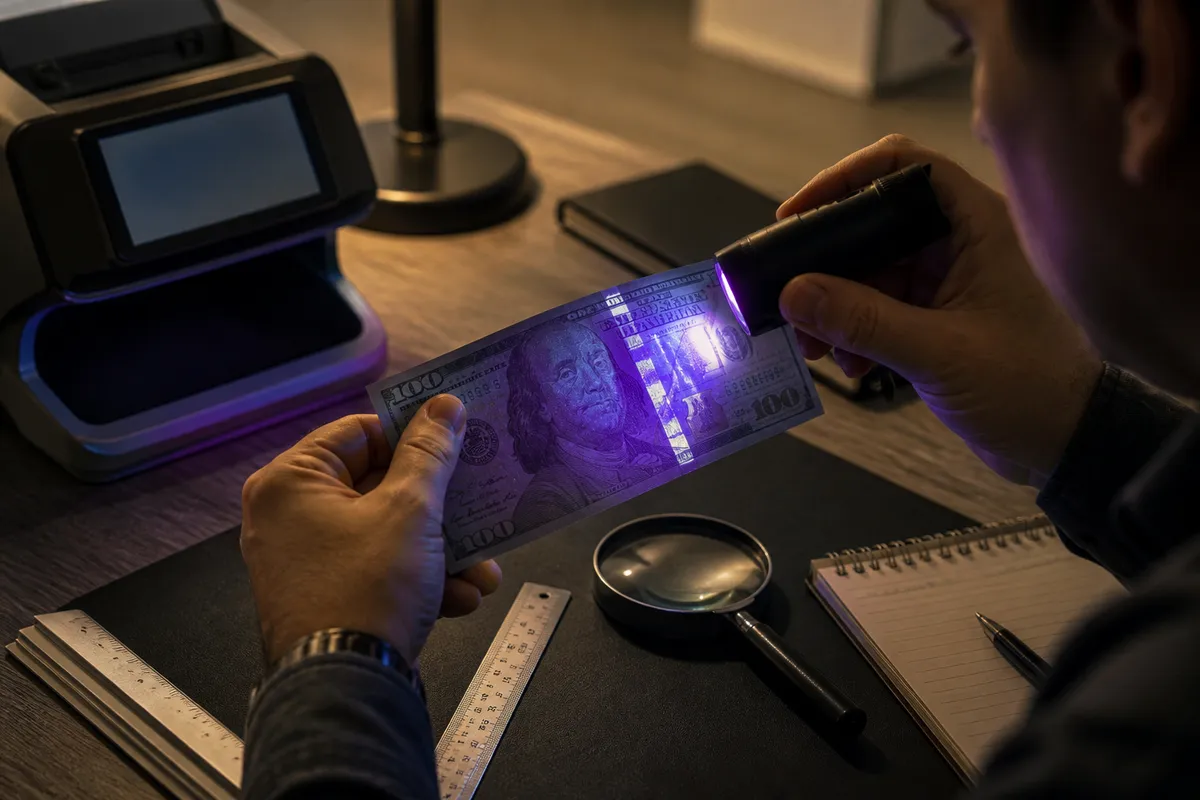
The security thread is embedded vertically to the left of Franklin's portrait. It reads “USA 100” and glows pink under ultraviolet light. This thread is visible from both sides of the bill when held up to light, making it challenging for counterfeiters to replicate (1) (4).
Color-Shifting Ink
The numeral “100” in the lower right corner features color-shifting ink, which changes from copper to green when tilted. This effect is difficult to reproduce effectively in fake templates (1).
3-D Security Ribbon
The blue 3-D security ribbon contains images of bells and “100s” that shift and move when the note is tilted. This ribbon is woven into the paper rather than printed on it, making it a distinctive feature not found in fake money templates (1).
Microprinting
Microprinting is present in various locations on the bill, including the collar of Franklin's jacket and around the portrait watermark. It displays text such as “THE UNITED STATES OF AMERICA” and “USA 100.” This fine detail is often overlooked in counterfeit versions (5).
Raised Printing
The paper used for the $100 bill feels unique due to raised printing, which gives it a slightly rough texture. This tactile feature is challenging to replicate in printable fake money templates (6).
UV Features
Under ultraviolet light, certain elements of the bill, including the security thread, glow in specific colors. This feature helps verify authenticity but is often absent in counterfeit notes (1).
When assessing a $100 bill, ensure these security features are present. If they are missing or poorly replicated, the bill is likely counterfeit. Always rely on these features to determine authenticity, especially when using or evaluating prop money for film production or educational purposes.
How to Spot a Fake 100 Dollar Bill Template: Visual Checklist
Identifying a fake $100 bill template involves careful observation of specific features. Here’s a step-by-step visual checklist to help spot fakes:
Step-by-Step Checklist
Paper Quality: Genuine $100 bills are made from a blend of 75% cotton and 25% linen. They should feel slightly rough due to raised printing. If the paper feels smooth, it's likely fake (6).
Watermark: Hold the bill up to the light. A faint image of Benjamin Franklin should be visible to the right of the portrait. Fake templates often lack this feature or it is poorly replicated (1).
Security Thread: Check for the vertical security thread to the left of Franklin’s portrait. It should read “USA 100” and glow pink under UV light. If it’s missing or poorly embedded, it’s a sign of a fake (1) (4).
Color-Shifting Ink: Tilt the bill to see if the numeral “100” in the lower right corner changes color from copper to green. Fake templates usually fail to replicate this effect (1).
3-D Security Ribbon: Look for the blue 3-D security ribbon. It should contain moving images of bells and “100s” that shift when tilted. If it’s printed rather than woven into the paper, it’s likely fake (1).
Microprinting: Inspect the bill for tiny text, such as “THE UNITED STATES OF AMERICA” on Franklin’s collar. Counterfeit versions often neglect this detail (5).
UV Features: Use a UV light to check which elements glow. Genuine bills have specific features that illuminate, while fakes typically lack these (1).
Common Mistakes in Fake Templates
Incorrect Serial Numbers: Fake templates may have unrealistic or repeated serial numbers.
Poor Alignment: Elements on the bill should align perfectly. Misalignment often indicates a fake.
Missing Fine Details: Features like microprinting or the watermark may be entirely absent in fake versions.
Comparison Table: Real vs. Fake Security Features
| Feature | Real $100 Bill | Fake Template |
|---|---|---|
| Paper Quality | Cotton-linen blend, textured | Smooth paper |
| Watermark | Visible when held to light | Often missing or poorly done |
| Security Thread | Embedded, glows pink under UV | Printed or missing |
| Color-Shifting Ink | Changes from copper to green | Usually static color |
| 3-D Security Ribbon | Woven into paper, moves when tilted | Printed, no movement |
| Microprinting | Present, includes detailed text | Often absent or poorly replicated |
| UV Features | Specific elements glow | Typically none |
When evaluating a $100 bill template, ensure it passes all these checks. Missing features or poor quality indicates a fake.
Common Types of Fake 100 Dollar Bill Templates Online
Fake 100 dollar bill templates come in various forms, each with its own characteristics. Understanding these types can help in identifying which templates are more realistic or easier to spot as fake.
Printable PDFs
Printable PDFs are widely available online. These templates can be downloaded and printed at home. While some PDFs mimic the appearance of real money, they often lack key security features. For example, they may not include the watermark or security thread that genuine bills possess.
PSD Files
Photoshop (PSD) files allow users to customize templates. These files can be edited to create various designs. However, realistic features like microprinting and color-shifting ink are typically absent. This makes them easier to identify as fake, especially if compared to a real bill.
Digital Generators
Online digital generators create fake 100 dollar bills on-demand. Users input values and receive a digital image. These templates may appear convincing at first glance, but they often fail to replicate essential security features. Relying on these for serious applications is not advisable.
Physical Replicas
Physical replicas are three-dimensional copies of the $100 bill. These are often used in film production or as novelty items. While some replicas can be quite realistic, they may still lack important features like the 3-D security ribbon or the UV-reactive security thread.
Realism and Detection
Printable PDFs and digital generators are often the easiest to spot as fake due to their low quality and lack of detail. Physical replicas can sometimes be more convincing, but they still typically miss critical security features like the watermark or the unique texture of genuine currency.
Common sources for these templates include platforms like Pinterest, Canva, and various free download sites. Users should exercise caution when selecting templates from these sources, as many do not comply with legal standards for fake currency.
In summary, understanding the types of fake 100 dollar bill templates available online can help the reader make informed decisions about their use.
Free vs. Paid 100 Dollar Bill Templates: What’s the Difference?
When deciding between free and paid 100 dollar bill templates, quality, realism, and customization options are key factors. Free templates often lack the essential details that characterize genuine currency. For example, they may miss critical security features like the watermark, security thread, and color-shifting ink present in real bills (1).
Quality and Realism
Free templates typically have low resolution and poor print quality. This can lead to a noticeable difference in appearance compared to real money. In contrast, paid templates from professional vendors are designed to closely mimic the look and feel of actual currency, including raised printing and texture (6). The higher quality of paid templates makes them more suitable for film production or educational purposes.
Customization Options
Paid templates often offer more customization options. Users can select specific designs, sizes, and features that align with their needs. Free templates, however, are generally limited and may not allow for any alterations. This can be a significant drawback if you need a specific look or functionality.
Risks of Free Templates
Using free templates carries certain risks. Many do not include important security features, which can lead to legal issues if used inappropriately. For instance, a counterfeit note can result in severe penalties, including fines and imprisonment (3). Additionally, low-quality prints can be easily identified as fake by anyone familiar with real currency.
Trusted Sources for Paid Templates
For those seeking realistic prop money, it’s advisable to purchase from trusted vendors. Professional prop money suppliers ensure that their products meet legal standards and replicate the security features of real currency. Always verify the reputation of the vendor before making a purchase.
In summary, while free templates may seem appealing, they often compromise on quality and realism. Investing in paid templates from reputable sources ensures a more authentic experience and reduces legal risks.
How to Verify a Template Before Printing or Using
Before printing or using a fake 100 dollar bill template, it’s crucial to perform a thorough verification. Here’s a pre-printing checklist to ensure your template mimics genuine currency effectively.
Pre-Printing Checklist
Resolution: Ensure the template has a high resolution. A minimum of 300 DPI is recommended for clear printing.
Dimensions: Compare the template's dimensions to a real $100 bill, which measures 6.14 inches by 2.61 inches. If the sizes differ significantly, it’s likely fake.
UV Features: If the template claims to have UV features, test them under a UV light. Genuine security threads glow pink under UV light, while fakes typically do not (1).
Microprinting: Check for microprinting. Genuine notes have fine details such as “THE UNITED STATES OF AMERICA” on Franklin’s collar (5). If this is missing or poorly rendered, the template may not be realistic.
Using a Magnifying Glass or UV Light
Using a magnifying glass can help examine fine details on the template. Look for microprinting and the texture of raised printing. Genuine bills feel slightly rough due to this raised printing (6).
For UV light verification, shine a UV light on the template. Genuine $100 bills feature a security thread that glows pink, and the watermark should be visible when held up to light (1). If these features are absent, consider the template suspect.
Red Flags to Watch For
Be aware of common indicators of a fake template:
Pixelation: If the image appears pixelated or blurry, it’s likely a low-quality replica.
Incorrect Dimensions: A significant size difference compared to a real bill is a clear sign of inauthenticity.
Missing Microprinting: Absence of microprinting or other fine details often indicates a counterfeit template.
By following this verification process, the reader can better assess the quality and authenticity of a fake 100 dollar bill template. Ensuring these features are present will help avoid potential legal issues related to counterfeit money laws (3).
Legal Considerations: What You Can and Can’t Do with Fake Money Templates
Understanding the legal landscape around fake money templates is crucial. In the U.S., laws regarding counterfeit money are strict. Under Title 18, Section 471 of the U.S. Code, it is a federal crime to knowingly manufacture, possess, or pass counterfeit obligations or securities, including currency. Penalties can include fines and imprisonment for up to 20 years (3).
Legal Uses of Fake Money Templates
Despite the strict laws, there are legal ways to use fake money templates. Common legal uses include:
Film Props: Many filmmakers use realistic prop money in productions. It’s important that this money is clearly marked as fake and does not resemble real currency closely enough to cause confusion.
Educational Tools: Teachers can use fake money templates to educate students about currency, financial literacy, and economics. These templates can help illustrate concepts without the legal risks associated with real money.
Novelty Gifts: Fake money can serve as a humorous gift or gag item. However, using it in a way that could be mistaken for real currency is illegal.
Illegal Uses and Potential Penalties
Using fake money templates in illegal ways can lead to serious consequences. For example, using a fake bill as real currency is a criminal act. Even if the intention is not to defraud, the law does not differentiate between intent and action.
If caught, individuals may face severe penalties, including criminal charges and imprisonment. The U.S. Secret Service emphasizes the importance of distinguishing between legal and illegal uses of fake currency (7).
Guidelines for Compliance
To ensure compliance with the law when using fake money templates, adhere to the following guidelines:
Size and Design: Any fake currency illustration should be less than three-fourths or more than one and one-half the size of the actual currency and one-sided (2).
Destruction of Materials: All materials used to create the fake currency should be destroyed after their final use to prevent any potential misuse (2).
Being aware of these legal considerations can help the reader navigate the complexities of using fake money templates responsibly and legally.
Where to Find High-Quality, Legal Fake 100 Dollar Bill Templates
Finding reputable sources for realistic fake 100 dollar bill templates can be challenging. It's essential to ensure that the templates comply with legal standards and maintain high quality. Here are some suggestions for where to find these templates.
Reputable Vendors
Professional Prop Money Suppliers: Companies specializing in prop money often provide high-quality templates designed for film production. These vendors ensure that their products include security features mimicking real currency, such as color-shifting ink and microprinting.
Licensed Template Providers: Look for vendors that offer licensed templates. These templates are crafted to meet legal requirements while providing realistic designs. They usually include key features like the watermark on the 100 dollar bill and security threads.
Online Marketplaces: Platforms like Etsy or Amazon may have sellers offering realistic prop money. Always check the reviews and ratings of the seller before making a purchase to ensure quality and legality.
Tips for Evaluating Quality
Before downloading or purchasing a template, consider the following tips to assess its quality:
Check for Security Features: Ensure the template includes essential features such as the color-shifting ink, watermark, and security thread visible under UV light (1). If these elements are missing, the template may not be realistic.
Resolution and Print Quality: A high-resolution template is crucial. Look for templates with at least 300 DPI for clear printing. Low-resolution images can result in pixelation and poor quality.
Physical Texture: Authentic prop money often mimics the texture of real currency. Check if the template is designed to replicate raised printing, which gives genuine bills their unique feel (6).
Trusted Websites or Platforms
Here are some trusted websites where you can find high-quality fake 100 dollar bill templates:
Etsy: A marketplace with various sellers offering licensed prop money.
Amazon: Look for products with high ratings and detailed descriptions.
Canva: Offers customizable templates that can be designed to include realistic features.
Pinterest: A great place to find ideas and links to vendors that sell quality templates.
By following these tips and using reputable sources, the reader can find high-quality, legal fake 100 dollar bill templates. This ensures a more authentic experience while minimizing potential legal issues.
Common Mistakes and Misconceptions
Assuming All Templates Include Security Features
Many users expect free or cheap templates to replicate the security features of a real $100 bill, such as the color-shifting bell or 3-D security ribbon (1). Most free templates skip these details, resulting in a visibly fake product. Always verify the presence of key features like the watermark or UV-reactive thread before use (1).
Ignoring Legal Size and Design Requirements
Some believe any fake bill design is legal if labeled as a prop. Federal law requires that illustrations of U.S. currency must be less than 75% or more than 150% the size of a real bill and one-sided (2). Failing to comply can result in legal consequences, even for novelty use.
Trusting Low-Resolution Templates
Low-resolution templates often appear blurry or pixelated when printed, making them easily identifiable as fake. Genuine bills have crisp, high-detail printing, including microprinting like “THE UNITED STATES OF AMERICA” on Franklin’s collar (5). A template lacking this clarity will not pass close inspection.
Skipping Pre-Printing Verification
Users sometimes print templates without checking dimensions, texture, or UV features. A real $100 bill has a unique texture due to raised printing and specific measurements (6.14 x 2.61 inches) (6). Overlooking these details can lead to a subpar or legally risky prop.
Believing All Paid Templates Are Legal
Paid templates are not automatically compliant with the law. Some vendors sell templates that closely mimic real currency, which can violate federal counterfeiting statutes (3). Always confirm the vendor’s adherence to legal size, design, and destruction requirements (2).
Key Takeaways
Always verify security features like UV threads, microprinting, and watermarks before using a template.
Ensure the template meets legal size and design requirements to avoid counterfeiting violations.
Use high-resolution templates (300 DPI or higher) to achieve realistic results.
Check vendor reputation and compliance with federal laws before purchasing.
Destroy all materials after use to prevent misuse.
For a deeper dive into identifying counterfeit currency, explore Fake 100 Dollar Bill: How to Identify One.
Good to know
Free printable fake 100 dollar bill template
Free templates often lack key security features like the color-shifting bell in the inkwell or the 3-D security ribbon (1). They may also omit microprinting, such as 'THE UNITED STATES OF AMERICA' on Franklin’s collar (5). Always check for these details before printing.
Fake 100 dollar bill template pdf
A PDF template should include the watermark of Benjamin Franklin visible from both sides when held to light (1). It must also match the real bill’s dimensions: 6.14 inches by 2.61 inches. If the PDF lacks these, it’s not realistic.
Custom dollar bill template free
Free custom templates rarely replicate the security thread that glows pink under UV light or the raised printing texture (1) (6). For legal use, ensure the design is one-sided and either less than 75% or more than 150% the size of a real bill (2).
Printable 100 Dollar bill front and back pdf
A printable PDF should include both the front and back, with the large gold numeral 100 on the reverse for visual impairment assistance (1). Verify the color-shifting numeral 100 in the lower right corner, which shifts from copper to green when tilted (1).
Sources and further reading
- $100 Note - Security Features | U.S. Currency Education Program
- Currency Image Use | U.S. Currency Education Program
- U.S.C. Title 18 - CRIMES AND CRIMINAL PROCEDURE
- CEP - Feel-Tilt-Check Card - English - 2024 (Digital) | U.S. Currency Education Program
- $100 Note | U.S. Currency Education Program
- CEP - Decoding Dollars - 100 - English (Digital) | U.S. Currency Education Program
- Counterfeit Investigations | U.S. Secret Service