Fake 100 Dollar Bill: How to Identify One
- First published:
- 12 min read
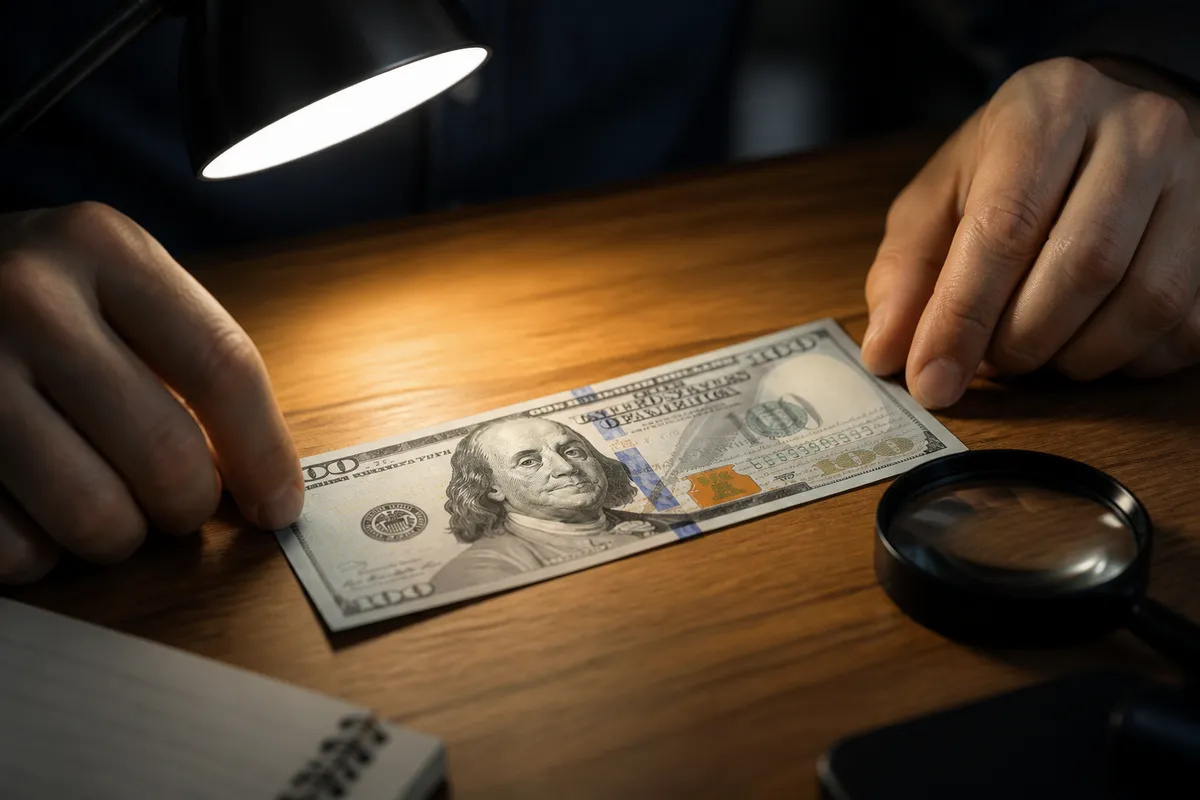
How to Check a $100 Bill by Look
Identifying a genuine $100 bill involves examining several key visual features. Start by looking for the color-shifting ink. The numeral "100" in the lower right corner changes from copper to green when tilted. This feature is essential for distinguishing real currency from counterfeits (2).
Next, check the watermark. A faint image of Benjamin Franklin should be visible from both sides of the bill when held up to the light. If the watermark is missing or poorly defined, the bill is likely a fake (2).
The 3-D security ribbon is another critical feature. It is woven into the paper, not printed, making it difficult for counterfeiters to replicate. When tilted, images of bells and "100s" on this ribbon move side-to-side and up-and-down (1) (4).
The blue security thread is embedded vertically to the left of Franklin’s portrait. It reads "USA 100" and glows pink under ultraviolet light (2). If this thread is absent or does not glow as expected, the bill is probably counterfeit.
Comparing real versus fake bills can help in the identification process. Genuine bills have sharp, clear edges, while counterfeits often exhibit blurry or fuzzy edges. Real colors are vibrant and match official standards; counterfeit bills may show mismatched or faded colors (3).
Microprinting is another detail to scrutinize. Genuine bills feature tiny text like "THE UNITED STATES OF AMERICA" on Franklin’s jacket collar and "USA 100" around the watermark. This text is hard to read without magnification (5).
Before concluding, ensure you utilize the "Feel, Tilt, Check" method: feel the texture, tilt the bill for color-shifting features, and check the watermark and security thread with light (1).
Being aware of these features makes spotting a counterfeit bill much easier.
How to Check a $100 Bill by Feel
Feeling the texture of a $100 bill is a crucial step in identifying its authenticity. Genuine bills have raised printing, which is created using intaglio ink. This ink gives the bill a tactile quality, especially noticeable on the portrait of Benjamin Franklin, the borders, and the numerals. When you run your fingers over these areas, they should feel slightly raised compared to the rest of the bill.
The paper used for the $100 bill is a blend of 75% cotton and 25% linen, giving it a distinct texture. This blend creates a slightly rough feel that is different from regular paper. If the bill feels smooth like standard paper, it is likely counterfeit (1).
To perform a simple test, run your fingers over the bill's surface. Focus on the areas with raised printing. If you notice a lack of texture or if the printing feels flat, the bill may not be genuine.
In addition to raised printing, take note of the overall feel of the bill. Genuine currency has a sturdiness that counterfeit bills often lack. If the bill feels flimsy or overly flexible, it might not be real.
Remember to use the "Feel, Tilt, Check" method as a comprehensive approach to verification (1). Feeling the texture is just one part of the process, but it can make a significant difference in identifying fake currency.
Being aware of these tactile features can help you spot a counterfeit $100 bill effectively.
How to Check a $100 Bill by Tilt
Tilting a $100 bill reveals important security features that help identify its authenticity. One of the most notable is the color-shifting ink located on the numeral "100" in the lower right corner. When the bill is tilted, this numeral changes from copper to green, a dynamic effect that counterfeit bills often lack (2).
Another feature to observe is the bell in the inkwell. When the bill is tilted, this bell appears and disappears. This effect is part of the advanced security measures that make the $100 bill difficult to replicate (3). If the bell does not change or is missing, the bill may be counterfeit.
To effectively check these features, hold the bill at an angle and observe the color shift. Make sure you are in a well-lit area to see the changes clearly. If the ink does not shift colors or the bell remains static, it is a strong indication of a fake bill.
Remember, counterfeit bills frequently lack these dynamic features. If you suspect a bill, don’t just stop at tilting; use the "Feel, Tilt, Check" method for a thorough evaluation (1).
Being aware of how to check for these color-shifting elements can significantly enhance your ability to spot counterfeit $100 bills.
Security Features You Might Miss (Common Overlooks)
Identifying a genuine $100 bill requires attention to several subtle security features that are often overlooked. Microprinting is one such detail that can be easily missed. Genuine bills feature tiny text, such as “USA 100” around the watermark and “THE UNITED STATES OF AMERICA” on Benjamin Franklin's jacket collar. This microprinting is difficult to read without magnification and is a strong indicator of authenticity (2) (5).
Another essential element is the Federal Reserve Seal and the Treasury Seal. The Federal Reserve Seal is located on the right side of the bill, and the Treasury Seal is on the left. Both seals are printed in a distinct color and have specific placements. The Federal Reserve Seal is green, while the Treasury Seal is a darker shade. If either seal appears faded or is absent, it may indicate a counterfeit (3).
Serial numbers on the $100 bill are unique to each note and should be evenly spaced. They should also match the bill’s series year, which can be found on the front of the bill. Genuine serial numbers are printed in black ink and should not have any irregularities, such as smudging or misalignment. If a bill has different serial numbers or if they seem poorly printed, it is likely counterfeit (1).
Using ultraviolet (UV) light can also help verify these features. Under UV light, the security thread embedded in the bill will glow pink, and the microprinting becomes more visible. This method is especially useful for those who handle large amounts of cash regularly (2) (6).
In summary, being aware of these often-missed features can greatly improve the ability to identify counterfeit $100 bills.
Red Flags: What Fake $100 Bills Often Get Wrong
Counterfeit $100 bills often miss crucial security features that genuine notes possess. Recognizing these red flags can help prevent losses. Here are the most common mistakes found in fake bills:
Missing Watermark
A genuine $100 bill features a faint watermark of Benjamin Franklin, visible when held up to light. If the watermark is absent or poorly defined, the bill is likely counterfeit (2).
Flat Printing
Real $100 bills have raised printing created using intaglio ink. Counterfeit bills often have flat printing, lacking the tactile quality that genuine notes exhibit. If the bill feels smooth, it may not be authentic.
Incorrect Color Shifts
The color-shifting ink on a real $100 bill changes from copper to green when tilted. Counterfeit bills frequently lack this feature or show inconsistent color shifts (2).
Mismatched Serial Numbers
Each $100 bill has unique serial numbers that should match the series year. If the serial numbers are unevenly spaced or poorly printed, it indicates a fake (1).
Poor Quality Paper
Genuine $100 bills are made from a blend of 75% cotton and 25% linen, giving them a slightly rough texture (1). Counterfeit bills often use regular paper, resulting in a flimsy feel.
Absence of Security Features
Low-quality fakes might lack key security features such as the blue security thread, which is embedded and glows pink under UV light (2). If this thread is missing or does not glow, the bill is likely counterfeit.
UV Light Checks
Using UV light can help identify counterfeit bills. Under UV light, the security thread should glow pink, and microprinting becomes more visible. If these features do not appear as expected, the bill may be fake (2) (6).
Being aware of these common mistakes makes it easier to spot counterfeit $100 bills effectively.
Quick Checklist: 5 Steps to Verify a $100 Bill in 30 Seconds
Identifying a genuine $100 bill can be straightforward. Here’s a quick checklist that combines the look, feel, and tilt methods to help you verify authenticity in just 30 seconds.
Feel the Texture: Run your fingers over the bill. Genuine $100 bills have a slightly rough texture due to the cotton and linen blend (75% cotton, 25% linen) used in their paper (1). If it feels smooth like regular paper, it may be counterfeit.
Check the Color-Shifting Ink: Tilt the bill and observe the numeral "100" in the lower right corner. It should shift from copper to green when tilted. If this effect is absent or inconsistent, the bill is likely fake (2).
Examine the Watermark: Hold the bill up to the light to see the faint image of Benjamin Franklin. This watermark should be visible from both sides. If it’s missing or poorly defined, it’s a red flag (2).
Look for the 3-D Security Ribbon: Tilt the bill to see the images of bells and "100s" move side-to-side and up-and-down on the 3-D Security Ribbon. This feature is woven into the paper, making it nearly impossible to replicate (1) (4).
Verify the Security Thread: Check for the blue security thread embedded vertically to the left of Franklin’s portrait. It should read "USA 100" and glow pink under ultraviolet light. If it’s absent or doesn’t glow, the bill is likely counterfeit (2).
If in doubt, compare the bill with a known genuine bill. This comparison can help highlight differences in texture, color, and security features.
Being aware of these steps enables effective identification of counterfeit $100 bills.
What to Do If You Receive a Fake $100 Bill
Receiving a counterfeit $100 bill can be alarming. It's essential to take specific legal steps immediately. First, do not attempt to pass the bill on to someone else. This could lead to legal consequences for knowingly distributing counterfeit currency.
Next, note the details surrounding the transaction. Record who gave you the bill, when, and where this occurred. These details can be crucial for law enforcement investigations.
Once you have this information, contact local law enforcement or the U.S. Secret Service. They are responsible for investigating counterfeiting cases and can provide guidance on what to do next (1). Reporting the incident helps authorities track the circulation of counterfeit money, potentially preventing further distribution.
It's important to understand that counterfeit money has no value. Attempting to exchange or use a fake bill is illegal. In the eyes of the law, counterfeit currency is treated the same as any other form of theft or fraud. Therefore, reporting it is not just a moral obligation; it is a legal one.
By alerting authorities, you're contributing to a larger effort to combat counterfeiting. The more reports they receive, the better they can track and tackle this issue.
In summary, if you find yourself with a counterfeit $100 bill, do not pass it on, document the details, and report it to the proper authorities. Your actions can help protect others from similar situations.
Common Mistakes and Misconceptions
Relying on a single check
Many assume checking just one feature, like color-shifting ink, is enough. Counterfeiters can replicate some elements, so a single test may miss flaws in others. Always use the full "Feel, Tilt, Check" method to confirm authenticity (1).
Trusting bills with "For Motion Picture Use Only"
Some think novelty or prop bills marked as replicas are harmless to pass. Any bill with foreign writing, "Replica," or "For Motion Picture Use Only" is not legal tender and is considered counterfeit (3).
Ignoring the paper texture
People often overlook the feel of the bill, assuming visual checks are sufficient. Genuine $100 bills use a 75% cotton and 25% linen blend, giving them a distinct, slightly rough texture. Smooth or flimsy paper is a red flag (1).
Assuming all UV features are visible
Not all security elements glow under UV light. The security thread glows pink, but other features like the 3-D Security Ribbon or watermark do not. Relying solely on UV checks can lead to false confidence (2) (6).
Overlooking microprinting
Counterfeiters often skip microprinting due to its complexity. Genuine bills have tiny, legible text in areas like Franklin’s collar or the golden quill. If the text is blurry or missing, the bill is likely fake (2) (5).
Missing these details can mean accepting a counterfeit without realizing it.
Key Takeaways
Genuine $100 bills have a rough texture, color-shifting ink, and a 3-D security ribbon that moves when tilted.
Always use the "Feel, Tilt, Check" method to verify multiple security features.
If a bill lacks a watermark, security thread, or UV glow, it’s likely counterfeit.
Do not pass a suspected fake bill; report it to law enforcement or the U.S. Secret Service.
Microprinting and serial number consistency are critical but often overlooked details.
For a deeper dive into verification techniques, check this step-by-step guide.
Good to know
How can you tell a fake $100 bill?
Check the texture—real bills have a rough feel from 75% cotton and 25% linen (1). Tilt the bill to see if the '100' shifts from copper to green; fakes often miss this (2). Look for the blue 3-D security ribbon with moving bells and '100s' (1). If any feature is missing or flat, it’s likely counterfeit.
Are there fake $100 bills that look real?
Yes, but they usually fail on subtle details. High-quality fakes may mimic the color-shifting ink or watermark but often lack the woven 3-D security ribbon or the correct paper texture (1) (4). Always verify multiple features.
How can I tell if a $100 dollar note is real or fake?
Use the 'Feel, Tilt, Check' method: feel the rough paper, tilt for color-shifting ink and the moving 3-D ribbon, and check the watermark and security thread under light (1). If the bill has 'For Motion Picture Use Only' or 'Replica,' it’s fake (3).
What to do if you get a fake $100 bill
Do not pass it on. Note the transaction details, then contact local law enforcement or the U.S. Secret Service (1). Counterfeit bills have no value, and attempting to use them is illegal.
Sources and further reading
- Decoding Dollars $100 | U.S. Currency Education Program
- $100 Note | U.S. Currency Education Program
- Teller Toolkit: A Guide to Identifying Genuine Currency | U.S. Currency Education Program
- $100 Note | U.S. Currency Education Program
- $100 Note | Bureau of Engraving and Printing
- CEP - Feel-Tilt-Check Card - English - 2024 (Digital)