Fake 20 Dollar Bill Motion Picture: Identification Tips
- First published:
- 14 min read
What Is a Motion Picture $20 Bill?
Motion picture money refers to prop currency specifically designed for use in film and television productions. This type of money is clearly marked as "For Motion Picture Use Only" or "Replica," indicating that it is not legal tender. Such labeling is crucial to distinguish it from real currency and to comply with legal regulations regarding the use of currency in media.
The primary purpose of motion picture money is to avoid the risks and complications associated with handling actual cash during filming. Using realistic-looking prop money allows production crews to maintain authenticity in scenes without the need to deal with real cash, which can be cumbersome and legally sensitive. These props can often be found in novelty shops, catering to filmmakers or collectors.
Common markings on motion picture $20 bills include phrases like "For Motion Picture Use Only" printed on both sides. This disclaimer helps to ensure that anyone handling the prop currency understands it is not real money and should be treated as such.
Unlike genuine $20 bills, which feature security elements such as a color-shifting ink, a security thread, and a watermark, prop money typically lacks these features. Real currency must adhere to strict guidelines set forth by the U.S. government to prevent counterfeiting. The Counterfeit Detection Act of 1992 allows for the creation of motion picture currency, provided it meets specific criteria, including size and destruction of materials after use (2) (3).
In summary, motion picture $20 bills are designed solely for visual effect in film and television, ensuring that productions can simulate real currency without the associated legal implications.
Key Visual Differences Between Real and Motion Picture $20 Bills
Identifying visual differences between real and motion picture $20 bills can prevent confusion. Here are key features to look for:
Security Thread
A genuine $20 bill has a security thread embedded vertically to the left of Andrew Jackson's portrait. This thread reads "USA TWENTY" and glows green under ultraviolet light (4). Motion picture prop money typically lacks this feature, making it easier to spot as fake.
Watermark
When held up to the light, a real $20 bill reveals a watermark of President Jackson located to the right of the portrait. This watermark can be seen from both sides of the note (4). Prop money does not include this watermark, which is a significant giveaway.
Color-Shifting Ink
The numeral "20" in the lower right corner of a genuine bill shifts from copper to green when tilted, thanks to color-shifting ink (4). This feature is often absent in prop versions, which may appear flat in color without any shifting effect.
Tactile Features
Real $20 bills have raised printing, creating a distinctive texture that can be felt by running a finger across the note (4). Prop money usually lacks this tactile quality, making it feel smooth and less authentic.
Microprinting
Genuine bills contain microprinting that includes the text "USA20" along the border of the blue "TWENTY USA" ribbon. This text can only be seen with magnification (5). Prop money typically does not feature this level of detail.
In summary, to differentiate real $20 bills from motion picture props, check for the security thread, watermark, color-shifting ink, tactile features, and microprinting. These elements are crucial for authenticity and are often missing in prop money.
Where to Look for the ‘Motion Picture Use Only’ Label
Finding the “For Motion Picture Use Only” label on prop $20 bills is essential for identifying them as fake currency. This label is typically printed in specific locations on the bill.
Exact Locations of the Label
Front Side: Look for the label near the bottom edge of the bill. It is often printed in a clear font.
Back Side: Some prop bills may have the label at the top or bottom corners. Always check both sides.
Corners: Inspect the corners of the bill, as labels can sometimes be placed discreetly there.
Font Styles and Sizes
The font used for the “For Motion Picture Use Only” label on prop money tends to be bold and clear. Common styles include sans-serif fonts that are easy to read. The size can vary but is usually around 12 to 14 points, making it noticeable without being overwhelming.
Warning About Subtle Labels
Be cautious of poorly printed labels. Some prop bills may feature subtle or faint text that can be hard to spot. If the label appears smudged or uneven, it could indicate a lower-quality reproduction. Always use good lighting when inspecting the bill.
Checklist for Identification
Before accepting any $20 bill for use in film production, ensure that:
The “For Motion Picture Use Only” label is present and legible.
The label is located on both sides of the bill.
The font is clear and not faded or smudged.
Recognizing these details can help prevent confusion between prop money and real currency.
In summary, check the front and back of the bill for clear labels, and be wary of subtle prints that may suggest lower quality.
How to Verify a $20 Bill’s Authenticity in 30 Seconds
Verifying the authenticity of a $20 bill can be done quickly using a few simple techniques. Follow this checklist to ensure you can distinguish between real currency and motion picture prop money effectively.
Step-by-Step Checklist
Tilt the Bill: Hold the bill at an angle. Look for the numeral "20" in the lower right corner. It should shift from copper to green due to color-shifting ink (4). If it doesn't change, it’s likely a prop.
Check for Watermarks: Hold the bill up to the light. A portrait watermark of President Jackson should be visible to the right of the portrait, visible from both sides (4). If the watermark is missing, it’s probably fake.
Feel the Texture: Run your fingers across the note. Genuine $20 bills have raised printing, creating a distinct texture (4). Prop money usually feels smooth and lacks this feature.
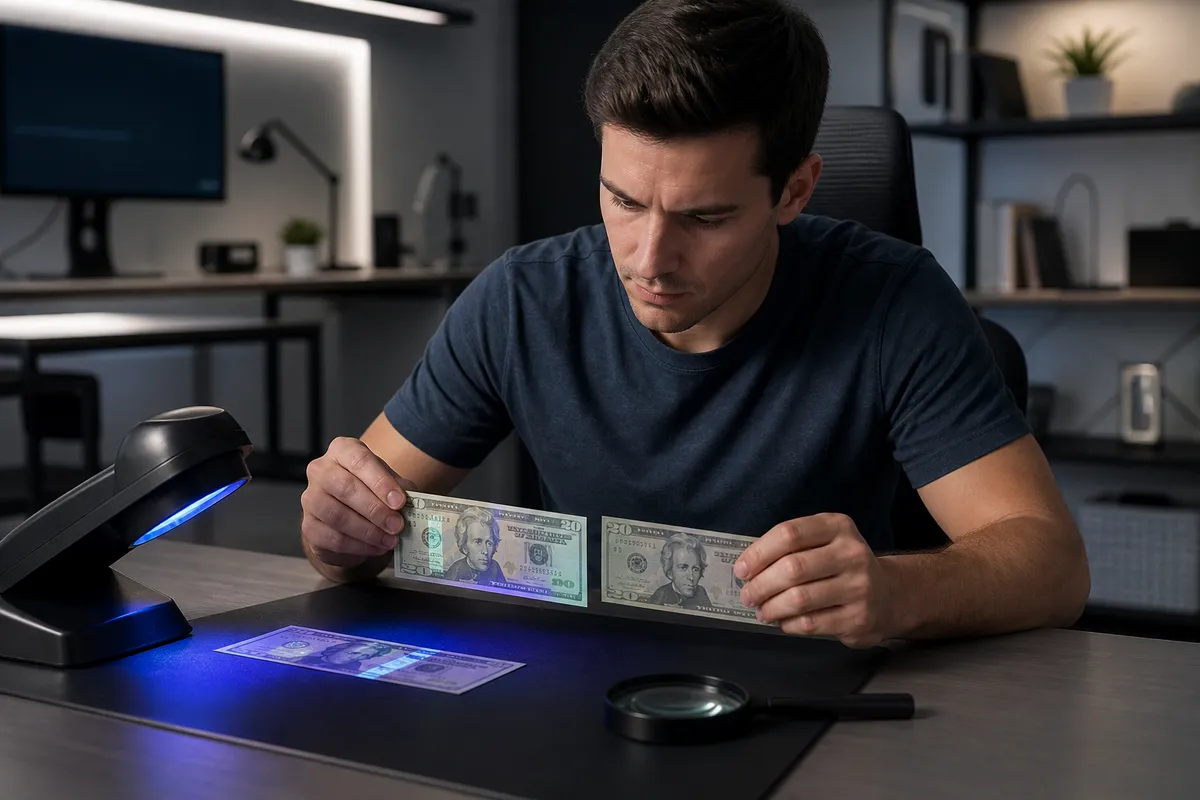
Use a UV Light: If available, shine a UV light on the bill. A genuine $20 bill has a security thread embedded vertically to the left of the portrait that glows green (4). If the thread is absent or does not glow, it indicates a prop.
Quick Reference Table
| Feature | Real $20 Bill | Prop Money |
|---|---|---|
| Security Thread | Embedded, glows green under UV | Typically absent |
| Watermark | Visible when held to light | Absent |
| Color-Shifting Ink | Changes from copper to green | No color shift |
| Texture | Raised printing | Smooth |
| Microprinting | Present, requires magnification | Usually absent |
Recommended Tools
Magnifying Glass: Use this to check for microprinting that includes "USA20" along the border (5). This detail is often missing in prop versions.
Counterfeit Detection Pens: While these pens can indicate some counterfeits, they may not be reliable for all types of prop money. They can give false positives on certain materials used in prop production.
In summary, by following these steps and using the right tools, the reader can effectively verify the authenticity of a $20 bill in under 30 seconds.
Common Mistakes When Identifying Motion Picture Money
Identifying motion picture money can be tricky. Here are some common mistakes to watch for.
Ignoring the Label
One frequent error is overlooking the "For Motion Picture Use Only" label. This label is crucial in distinguishing prop money from real currency. Many novice users may assume any realistic-looking bill is authentic, especially when props are designed to mimic the appearance of real money. However, all legitimate prop money must have this clear labeling to comply with legal standards (1).
Assuming All Props are Low-Quality
Another common misconception is assuming that all prop money is of low quality. Some motion picture prop bills closely resemble genuine currency, making it easy to confuse them. High-quality replicas may lack obvious visual cues, leading individuals to mistakenly accept them as real money. For example, some prop bills used in films can appear very realistic, yet they still have the required labels indicating their status as replicas.
Real-World Examples
Incidents involving the misuse of prop money have occurred in various locations. In the Florida Keys, for instance, a group was caught attempting to use realistic-looking prop bills in local businesses. They were eventually reported, leading to an investigation by the U.S. Secret Service (6). Such cases illustrate the potential for confusion and misuse, highlighting the importance of proper identification.
In summary, being aware of these common mistakes can help the reader accurately identify motion picture money and avoid potential legal issues.
What to Do If You Receive a Motion Picture $20 Bill
Receiving a motion picture $20 bill can be confusing. Here’s what to do if you encounter one.
Steps to Take
Do Not Accept It as Payment: If someone tries to use a motion picture $20 bill, do not accept it. Inform the person that it is a prop and not legal tender. This helps prevent misunderstandings and potential legal issues.
Inform the Individual: Clearly explain that the bill is labeled "For Motion Picture Use Only" or "Replica." These labels indicate that the bill is not intended for real transactions (1).
Report to Authorities If Fraud Is Suspected: If you suspect that the bill is being used fraudulently, report it to the authorities. Contact your local law enforcement or the U.S. Secret Service. As of November 1, 2024, individuals must reach out directly to their local U.S. Secret Service field office to report counterfeit notes (6).
Legal Implications
Using prop money as real currency is illegal. The Counterfeit Detection Act of 1992 outlines strict regulations regarding the reproduction of U.S. currency, including prop money (2). While owning motion picture money is legal, using it as actual currency can lead to serious legal consequences.
18 U.S. Code § 504 allows for the use of color illustrations of U.S. currency in films, as long as no prints are made from these films and all materials are destroyed after use (3). Understanding these regulations is essential for anyone involved in film production or handling prop money.
Contact Information
For local law enforcement, check your city or county's website for contact details. If you need to report counterfeit money to the U.S. Secret Service, find your nearest field office online.
In summary, if you receive a motion picture $20 bill, do not accept it, inform the person, and report any suspected fraud to the authorities. Understanding the legal implications helps ensure compliance with the law.
Why Motion Picture Money Ends Up in Circulation
Motion picture money can find its way into everyday life in various unexpected ways. One common scenario is when prop money is sold as souvenirs. Tourists may purchase realistic-looking bills as a novelty item, thinking they are harmless keepsakes. Others may use prop money in pranks, attempting to trick friends or family into believing they have received real cash. Unfortunately, this can lead to confusion and even legal issues if the prop money is mistaken for genuine currency.
There have been notable incidents reported in the news regarding the misuse of prop money. In Toronto, a group was caught attempting to use realistic-looking prop bills in local businesses, sparking an investigation by authorities. Similarly, in the Florida Keys, individuals were reported for trying to spend prop money at shops, leading to further scrutiny and action by the U.S. Secret Service (6). These cases highlight the potential for confusion and the importance of clear identification of such bills.
Some sellers of prop money may mislead buyers about the legality of using these items. While owning motion picture money is legal, using it in transactions can lead to serious consequences. The Counterfeit Detection Act of 1992 outlines strict regulations on the reproduction of U.S. currency, including prop money (2). Buyers should be aware that any bill labeled "For Motion Picture Use Only" or "Replica" is not legal tender and should not be used as such (1).
In summary, prop money can inadvertently enter circulation through sales as souvenirs or pranks, often leading to confusion and legal issues. Awareness of the regulations surrounding prop money is essential for anyone involved in its use or sale.
Common Misconceptions About Motion Picture $20 Bills
Assuming the Label Is Always on the Front
Many users expect the “For Motion Picture Use Only” label to appear only on the front of the bill. In reality, it can be placed on the back, corners, or even along the edges. Overlooking these locations may lead to accepting prop money as real currency (1).
Trusting the Feel of the Paper
Genuine $20 bills have a distinct texture due to raised printing and cotton-linen composition (4). Some assume prop money will always feel flimsy or plastic-like, but high-quality replicas can mimic this texture closely. Always pair the feel test with other checks like the security thread or watermark (7).
Ignoring the Security Thread Under UV Light
A genuine $20 bill’s security thread glows green under UV light (4). Some users skip this step, assuming prop money won’t include any UV-reactive elements. However, low-quality props may lack this feature entirely, making UV verification a quick way to confirm authenticity (7).
Believing All Prop Money Is Illegal to Own
While using prop money as real currency is illegal, owning it for film or novelty purposes is permitted under specific conditions. The Counterfeit Detection Act of 1992 allows replicas if they meet size and destruction requirements (2) (3). Misunderstanding this can lead to unnecessary alarm when handling labeled props.
Relying Solely on Color-Shifting Ink
The numeral "20" in the lower right corner shifts from copper to green on genuine bills (4). Some props replicate this effect poorly or omit it entirely, but others may mimic it convincingly. Always cross-check with other features like the watermark or microprinting (5).
Overlooking these nuances can result in confusion between prop and real currency.
Key Takeaways
Always check for the “For Motion Picture Use Only” label, even on the back or edges.
Verify the security thread under UV light—it should glow green on a real $20 bill.
Combine texture, watermark, and microprinting checks for accurate identification.
Remember that owning prop money is legal, but using it as real currency is not.
For more details on identifying counterfeit money, explore Check Counterfeit Money: A Step-by-Step Guide.
Good to know
Is the money used in movies real?
No, real currency is rarely used in films. Motion picture prop money is designed to resemble real bills but must include labels like 'For Motion Picture Use Only' or 'Replica' to comply with legal standards (1).
How can you identify a fake dollar?
Check for the 'For Motion Picture Use Only' label first. Then use the 'feel, tilt, check' method: feel the raised printing, tilt for color-shifting ink, and check the security thread and watermark under light (7) (4).
What image is on the back of a $20 bill?
The back of a genuine $20 bill features a vignette of the White House (4). Prop versions may replicate this but will lack security features like the glowing thread or watermark.
Is my $20 bill worth anything?
If it has 'For Motion Picture Use Only' or 'Replica' printed on it, it has no monetary value and is not legal tender (1). Genuine $20 bills retain their face value.
Fake 20 dollar bill motion picture reddit
Discussions on platforms like Reddit often highlight realistic prop $20 bills used in films. These props must include labels like 'For Motion Picture Use Only' to avoid legal issues (1). Always verify such labels before handling.
Best fake 20 dollar bill motion picture
The best motion picture prop $20 bills are those that closely mimic real currency but include clear labels like 'Replica' or 'For Motion Picture Use Only' (1). High-quality props may lack security features like the UV-reactive thread or watermark.
Sources and further reading
- Teller Toolkit: A Guide to Identifying Genuine Currency | U.S. Currency Education Program
- U.S. Currency's Starring Role in Film | Federal Reserve Bank of San Francisco
- 18 U.S.C. § 504: Printing and filming of United States and foreign obligations and securities
- $20 Note | U.S. Currency Education Program
- $20 Note Security Features | U.S. Currency Education Program
- Report a Counterfeit | U.S. Currency Education Program
- Training Course - Security | U.S. Currency Education Program