Fake money 20 dollar bill
- First published:
- 13 min read
How to Spot a Fake $20 Bill: 7 Key Security Features
Identifying a counterfeit $20 bill can save you from financial loss. Here are seven key security features to look for:
Security Thread
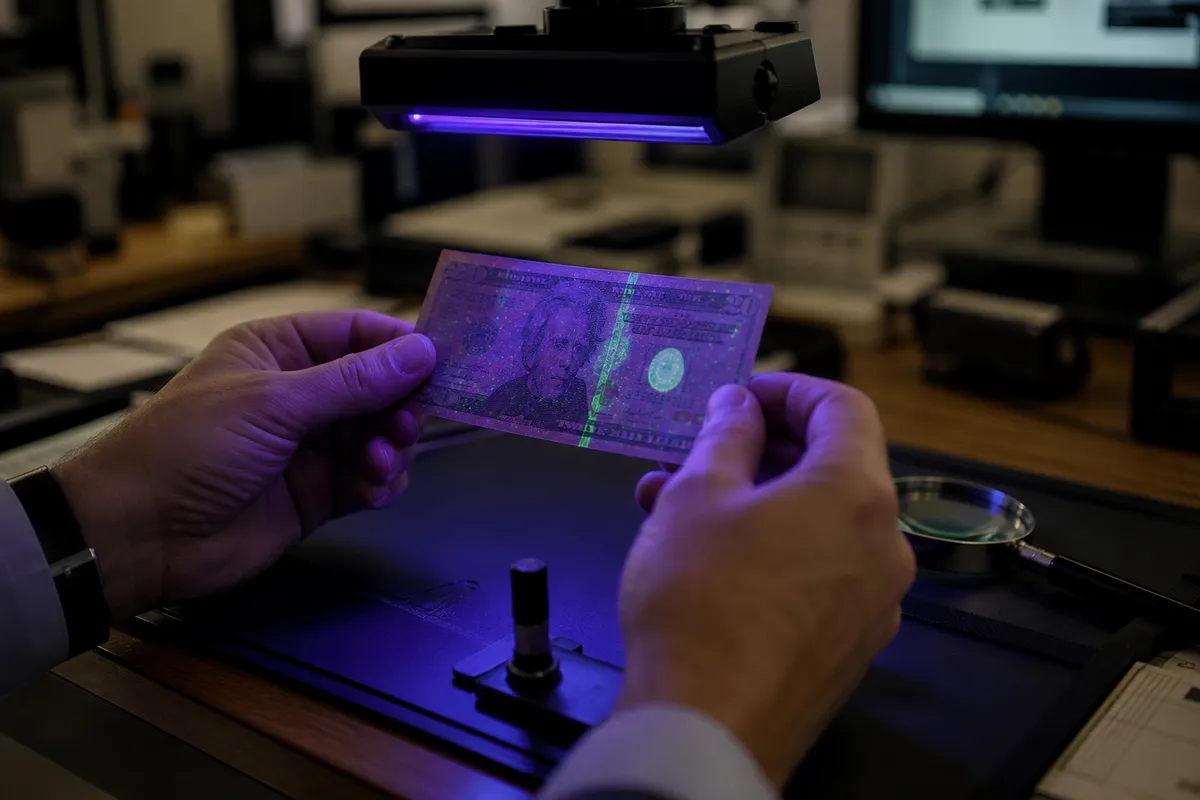
The genuine $20 bill includes a security thread that glows green under UV light. It is embedded vertically to the left of the portrait and imprinted with the words "USA TWENTY" and a flag. Counterfeit bills often lack this feature or have an incorrectly placed thread (1).
Watermark
A faint image of President Jackson serves as a watermark. This feature is visible from both sides of the note when held up to the light. Many counterfeit versions either do not have a watermark or the image is poorly replicated (1).
Color-Shifting Ink
The numeral 20 on the front of the bill features color-shifting ink. When tilted, the color changes from copper to green. This feature can be challenging for counterfeiters to replicate accurately (2).
Microprinting
Genuine $20 bills contain microprinting in various locations, including around the portrait and on the security thread. Counterfeit bills usually lack this detail or have blurry microprinting (1).
Raised Printing
The texture of the bill is slightly rough due to the raised printing process. This tactile feature is often missing in counterfeit notes, which may feel smooth (5).
UV Features
Under ultraviolet light, certain elements of the $20 bill, such as the security thread and other inks, will appear differently than in counterfeit versions. Always check for these features in low light (1).
Serial Number Consistency
The serial numbers on genuine bills are evenly spaced and printed in a specific font. Counterfeit notes may have inconsistent spacing or incorrect fonts. Always compare the serial number with a known genuine bill for accuracy.
When inspecting a $20 bill, ensure that all these features are present and correctly executed. Counterfeiters often overlook one or more of these details, making them easier to spot.
Being aware of these features can help prevent falling victim to counterfeit money.
Common Mistakes in Counterfeit $20 Bills (and How to Catch Them)
Counterfeit $20 bills often contain several common mistakes that reveal their true nature. Recognizing these errors can help identify fake currency quickly.
Blurry Printing
Genuine bills feature sharp, clear printing. Counterfeit notes frequently show blurry images and text. This is due to lower-quality printing methods used by counterfeiters. For example, the intricate details of President Jackson's portrait may appear smudged or distorted in fakes.
Incorrect Font
The font on a real $20 bill is specific and consistent. Counterfeit notes might use different fonts or sizes, especially on the serial numbers. Always compare the font with a known genuine bill to spot inconsistencies.
Mismatched Serial Numbers
Each genuine $20 bill has a unique serial number that follows a specific format. Counterfeit bills often feature serial numbers that are poorly printed or do not match the correct sequence. Checking the serial number against a legitimate bill is crucial.
Wrong Paper Texture
Genuine currency paper has a unique texture that feels slightly rough due to the printing process. Counterfeit bills may feel smooth or different in texture. This tactile feature is easy to check by running fingers over the bill (5).
Missing Security Features
Real $20 bills contain security features like a security thread, watermark, and color-shifting ink. Counterfeit versions may lack these elements entirely or replicate them poorly. For instance, the security thread should glow green under UV light, while counterfeit bills often fail to reproduce this accurately (1).
Raised Printing
Real currency has raised printing that can be felt by touch. Many counterfeit bills lack this feature or present it poorly. If the bill feels flat, it’s likely fake (5).
Recognizing these common mistakes can save time and money. Always examine bills closely for these red flags before accepting them.
Prop Money vs. Counterfeit Money: Legal and Practical Differences
Prop money is specifically designed for use in film production and other entertainment venues. It typically features disclaimers such as "For Motion Picture Use Only" or "For Novelty Use Only." This clear labeling ensures that prop money is recognized as non-legal tender, distinguishing it from genuine currency.
The legal status of prop money is straightforward: it is legal to produce and use as long as it is marked appropriately. In contrast, counterfeit money is illegal. Producing or using counterfeit currency with the intent to defraud can lead to severe penalties, including fines and up to 20 years in prison under 18 U.S. Code § 471 (3).
To avoid confusion, prop money is often designed with distinct features. For example, it may use different colors, sizes, or markings compared to real currency. While genuine $20 bills have specific security features like a security thread that glows under UV light, prop money may lack these elements entirely or replicate them poorly (1).
When using prop money, ensure it is clearly labeled and distinguishable from real currency to avoid potential legal issues. For instance, a prop bill might be printed on a different type of paper or have a different texture than genuine bills, making it easy to identify as fake.
Being aware of these differences can help the reader navigate the legal landscape surrounding prop money and prevent accidental use of counterfeit currency.
Where to Buy Realistic Prop Money (Without Breaking the Law)
Finding reputable sources for realistic prop money is crucial for legal compliance. Several trusted vendors offer high-quality prop money that is clearly marked for novelty use. Some recommended sources include:
Money Prop: Known for its variety of prop money options, this vendor provides bills that are labeled "For Motion Picture Use Only."
Prop Money Store: This store specializes in prop money for film and theater, ensuring their products comply with legal standards.
Amazon: Look for listings that include clear disclaimers stating the money is for novelty use. Always check customer reviews for reliability.
When shopping for prop money, be wary of scams or illegal sellers. Avoid vendors claiming to offer "undetectable" counterfeit bills. Such claims are often a red flag, as they may lead to legal trouble. Using counterfeit currency, even unintentionally, can result in severe penalties, including fines or imprisonment (3) (4).
To verify a seller's legitimacy, consider these tips:
Check Labels: Ensure that the product is labeled "For Motion Picture Use Only" or "For Novelty Use Only." These labels indicate that the money is not intended for actual transactions (5).
Research the Seller: Look for established businesses with positive reviews. A quick online search can reveal customer experiences and potential red flags.
Request Samples: If possible, ask for samples to assess the quality and labeling before making a bulk purchase.
Being diligent in your search for prop money can help avoid legal complications. Always prioritize reputable sources to ensure compliance with the law.
What to Do If You Receive a Fake $20 Bill
Receiving a fake $20 bill can be alarming. It's crucial to handle the situation correctly to avoid legal issues. Here are step-by-step actions to take:
Do Not Pass It On
First and foremost, do not attempt to use or pass the counterfeit bill. Doing so can lead to serious legal consequences. Under 18 U.S. Code § 472, attempting to pass counterfeit currency can result in a fine and/or up to 20 years in prison (4).
Note Details
If you realize you have a fake bill, take a moment to note important details. Record the time and location where you received the bill. If possible, describe the person who gave it to you. This information can be valuable for law enforcement.
Contact Local Law Enforcement or the Secret Service
Next, report the counterfeit bill. Contact your local law enforcement agency or the U.S. Secret Service. You can also report it online at uscurrency.gov/report-counterfeit (5). In 2023, the Secret Service seized $21.8 million in counterfeit currency, highlighting the importance of reporting such incidents (6).
Understand Consequences of Using Counterfeit Money
Using counterfeit money, even accidentally, can lead to legal repercussions. If you knowingly pass a counterfeit bill, you could face fines and imprisonment (3). Being unaware may not exempt you from liability, so it’s essential to act responsibly.
Resources for Reporting
For additional guidance, visit the U.S. Secret Service website. They provide resources and information on counterfeit currency. You can also reach out to your local police non-emergency line for assistance.
Taking these steps promptly can help mitigate the situation. Understanding the legal ramifications of counterfeit money is crucial for avoiding potential penalties.
Old vs. New $20 Bills: Are Older Designs Still Valid?
All U.S. currency remains valid, regardless of its age. This includes older designs of the $20 bill, which continue to be legal tender as per U.S. government policy (7).
Over the years, the $20 bill has undergone several design changes. For instance, the 1990s series featured a more traditional design, while the 2003 redesign introduced several advanced security features. These include color-shifting ink, which allows the numeral "20" to shift from copper to green when tilted (2). This feature makes it more difficult for counterfeiters to replicate accurately.
While older bills may lack some of the modern security features, they are still accepted for transactions. Older designs do not include features like the color-shifting ink or enhanced microprinting that were introduced in newer bills. However, they still possess essential security elements such as a security thread that glows under UV light and a watermark of President Jackson visible when held up to the light (1).
It is important to note that the absence of modern features does not render older $20 bills invalid. They can still be used for purchases and payments without issue.
When using or accepting currency, awareness of these design changes helps in identifying genuine bills. Counterfeiters often target older designs due to their lack of advanced features, making it crucial to be vigilant.
Understanding the differences between old and new $20 bills can help the reader navigate transactions confidently.
Fake $20 Bills in Circulation: Recent Cases and Trends
Counterfeit $20 bills remain a significant issue in the United States. Recent reports indicate that in fiscal year 2023, approximately $14 million in counterfeit $20 bills were passed, contributing to the larger total of $102 million in counterfeit currency overall (8). Communities are increasingly vigilant, with local law enforcement agencies issuing warnings. For instance, Gloucester Township recently cautioned residents about the potential circulation of movie prop money, emphasizing the need for careful scrutiny during transactions.
Common scenarios for encountering counterfeit $20 bills include online marketplaces, such as Facebook Marketplace, where sellers may unknowingly accept fake currency. Small businesses are particularly vulnerable, as they often handle cash transactions without advanced detection tools. In these environments, counterfeiters may take advantage of unsuspecting vendors.
To protect against counterfeit bills, it is essential to remain vigilant during everyday transactions. Here are some key points to consider:
Check Security Features: Always examine the security thread, watermark, and color-shifting ink. Genuine $20 bills possess these features, making them difficult to replicate (1).
Be Wary of Online Transactions: If purchasing items online, ask sellers about their payment practices and be cautious of unusually low prices.
Educate Yourself on Counterfeit Detection: Familiarize yourself with the specific characteristics of genuine $20 bills. This knowledge can help identify counterfeits quickly.
If a counterfeit bill is suspected, it is crucial to report it immediately to the U.S. Secret Service or local law enforcement (5). Recognizing the prevalence of counterfeit currency and understanding how to spot it can significantly reduce the risk of falling victim to fraud.
Common Mistakes and Misconceptions
Assuming All Older $20 Bills Are Fake
Many people discard or refuse older $20 bills, believing they are no longer valid. In reality, all U.S. currency remains legal tender regardless of its design or age (7) (9). Older bills lack modern security features but are still genuine. Always accept them unless you spot clear signs of counterfeiting.
Ignoring the Watermark
Some users skip checking the watermark, assuming it’s hard to see. A genuine $20 bill has a faint image of President Jackson visible from both sides when held to light (1). Counterfeit bills often omit this or print a blurry version. Tilt the bill to confirm the watermark’s clarity.
Trusting UV Light Alone
UV light reveals the security thread in a real $20 bill, which glows green and is embedded vertically to the left of the portrait (1). However, some counterfeiters add fake threads that glow under UV. Always combine this check with other features like the color-shifting numeral 20 (1) (2).
Believing Prop Money Is Legal Tender
Prop money marked “For Motion Picture Use Only” or “Replica” is not legal tender and cannot be used in real transactions (5). Using it as genuine currency, even accidentally, can lead to legal consequences under 18 U.S. Code § 471 or § 472 (3) (4). Always ensure prop money is clearly labeled and never passed as real.
Overlooking the Feel of the Paper
Genuine U.S. currency has a unique, slightly rough texture due to its cotton-linen blend and printing process (5). Counterfeit bills often use standard paper, which feels smoother or flimsier. Run your fingers over the bill to detect the difference.
Thinking Counterfeit Bills Are Rare
The $20 bill is the most counterfeited U.S. denomination, with an estimated $14 million in fake $20 bills passed in 2023 (8) (10). Small businesses and cash transactions are frequent targets. Always inspect bills carefully, especially in high-risk scenarios.
Key Takeaways
All U.S. $20 bills remain valid, regardless of age, but older designs lack modern security features (7).
Genuine bills have a watermark, color-shifting ink, and a UV-glowing security thread—check all three (1) (2).
Prop money is legal only if clearly labeled for novelty use and never passed as real (5).
Counterfeit $20 bills are common, with $14 million passed in 2023—always verify suspicious bills (8).
If you receive a fake bill, do not use it; report it to the U.S. Secret Service or local law enforcement (5).
Next, learn how to identify other counterfeit denominations in the guide Fake US Dollars: How to Spot Them.
Good to know
Are there fake $20 bills?
Yes, the $20 bill is the most counterfeited U.S. denomination. In 2023, an estimated $14 million in counterfeit $20 bills were passed in circulation (8) (10). Genuine bills have security features like a watermark, color-shifting ink, and a UV-glowing thread to help distinguish them (1).
What is the best realistic prop money available?
The best realistic prop money is clearly labeled 'For Motion Picture Use Only' or 'Replica' and mimics genuine bills in design but lacks security features like color-shifting ink or a watermark (5). Avoid sellers offering 'undetectable' prop money, as this may indicate illegal counterfeit production.
What happens if you accidentally pay with counterfeit money?
Passing counterfeit money, even unintentionally, can lead to legal consequences. Under 18 U.S. Code § 472, it is punishable by a fine and/or up to 20 years in prison (4). If you realize you have a fake bill, do not pass it on and report it immediately (5).
Are old $20 bills still valid?
All U.S. currency, including older $20 bills, remains legal tender regardless of design or age (7) (9). Older bills lack modern security features but are still accepted for transactions.
Where to buy fake money 20 dollar bill
Legal prop money for novelty or film use can be purchased from reputable vendors. Ensure the product is labeled 'For Motion Picture Use Only' or 'For Novelty Use Only' to avoid legal issues (5). Avoid sellers claiming to offer undetectable or real-looking counterfeit bills.
Sources and further reading
- $20 Note Security Features | U.S. Currency Education Program
- Teller Toolkit: A Guide to Identifying Genuine Currency | U.S. Currency Education Program
- 18 U.S. Code § 471 - Obligations or securities of United States
- 18 U.S. Code § 472 - Uttering counterfeit obligations or securities
- Quick Glance Reference Card | U.S. Currency Education Program
- Is your cash counterfeit? Here's how to tell | The Hill
- Use of Older-Design Notes | U.S. Currency Education Program
- Estimating the Volume of Counterfeit U.S. Currency in Circulation | Federal Reserve
- Do I have to trade in my old-design notes? | Federal Reserve
- Learn How to Spot Fake Money Before it Reaches Your Wallet | U.S. Secret Service