Realistic Fake 100 Dollar Bills: Characteristics
- First published:
- 12 min read
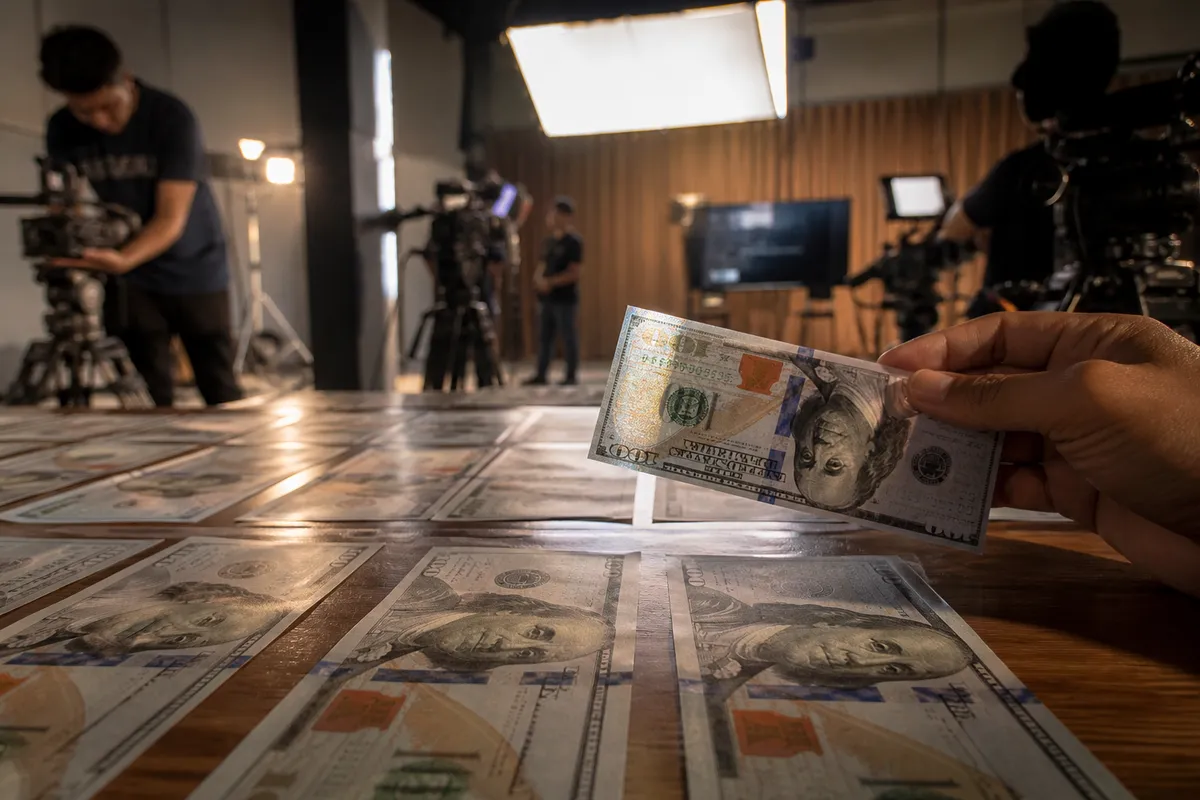
What Makes a Fake $100 Bill Look Realistic?
Identifying realistic fake $100 bills involves understanding several key features. These characteristics can help distinguish high-quality replicas from low-quality imitations.
Paper quality is crucial. Genuine $100 bills are made of 75% cotton and 25% linen, giving them a distinctive texture that feels slightly rough due to raised printing (4). In contrast, many fakes use regular paper, which lacks this tactile quality.
Color-shifting ink is another vital feature. The genuine note has a color-shifting bell in the inkwell that transitions from copper to green when tilted (3). This shifting effect is difficult to replicate accurately, making it a reliable authentication method.
Watermarks and security threads are essential for distinguishing real currency. A genuine $100 bill features a watermark of Benjamin Franklin visible from both sides when held to the light (3). Additionally, the security thread is embedded vertically to the left of Franklin's portrait and glows pink under ultraviolet light (3). These features are often missing or poorly replicated in fake bills.
Microprinting adds another layer of security. The genuine $100 bill includes tiny text, such as “THE UNITED STATES OF AMERICA” on Franklin's jacket collar and “USA 100” around the watermark (5). This detail is challenging for counterfeiters to replicate.
Lastly, the 3-D security ribbon woven into the paper is a unique feature of the real bill. It displays images of bells and 100s that shift and move when the note is tilted (3). This intricate design is hard to duplicate, making it a hallmark of authenticity.
Understanding these visual and tactile features can help the reader identify realistic fake $100 bills effectively.
Legal Uses of Realistic Prop $100 Bills
Realistic prop $100 bills have various legal applications. Common uses include film and TV production, music videos, pranks, parties, and educational purposes. Each scenario requires careful consideration of legal guidelines to avoid complications.
In film and TV, prop money is essential for creating realistic scenes. Productions often utilize these bills to depict transactions without the risk of using real currency. Music videos also frequently feature prop money to enhance the visual appeal. For pranks and parties, realistic fake bills can provide comedic value or serve as novelty gifts. Educational settings may use prop money to teach financial literacy or simulate real-world transactions.
Legal restrictions are crucial when using prop money. According to the Counterfeit Detection Act of 1992, prop money must differ in size from real currency. It should be either smaller than 75% or larger than 150% of the actual size, one-sided, and all production materials must be destroyed after use (1). Federal law explicitly allows filming U.S. currency for motion pictures, but compliance with the Counterfeit Detection Act is necessary to avoid legal issues (1).
To distinguish prop money from real currency, it should feature a disclaimer such as “For Motion Picture Use Only.” This marking is vital to prevent confusion and maintain legal compliance (2). Failure to properly label prop money can result in it being mistaken for genuine bills, leading to unintended legal consequences.
Understanding the legal framework surrounding prop money use is essential for anyone considering its application in various settings. Proper adherence to guidelines ensures safe and effective use while avoiding legal pitfalls.
How to Spot High-Quality Prop Money vs. Low-Quality Fakes
Identifying high-quality prop money can save time and money. Key features help distinguish premium replicas from their low-quality counterparts.
Print resolution is vital. High-quality prop money features crisp, clear images. Look for fine details in the portrait of Benjamin Franklin and the intricate designs on the bill. Cheap fakes often have blurry prints or missing details.
Edge details are also telling. Genuine $100 bills have sharp, well-defined edges. Poorly made replicas may have uneven or poorly cut edges. This can indicate a lack of attention to detail, affecting the overall realism.
Holograms are an essential feature of authentic currency. While high-quality prop money may not replicate this perfectly, it should attempt to mimic the look. Check for any shiny, reflective elements that resemble holograms.
UV ink can be a game-changer. Genuine $100 bills include security threads that glow pink under ultraviolet light (3). If the prop money lacks this feature or fails to glow, it may be a low-quality imitation.
A checklist for buyers might include:
Does it have a 3-D security ribbon?
Is there a color-shifting bell that changes from copper to green?
Can you see a watermark of Benjamin Franklin when held to the light?
Is there a security thread embedded vertically and glowing under UV light?
Are there any microprinting details visible on the bill?
By examining these features, the reader can more confidently choose high-quality prop money for legal uses, avoiding low-quality fakes that could ruin a production or prank.
Real $100 Bill vs. Fake: Side-by-Side Comparison
Understanding the differences between real and realistic fake $100 bills is crucial for identification. Here’s a comparison highlighting key features:
Texture and Material
Real $100 Bill: Made from 75% cotton and 25% linen, giving it a slightly rough texture due to raised printing (4).
Fake $100 Bill: Often printed on regular paper, lacking the distinctive texture.
Security Features
3-D Security Ribbon:
Real: Woven into the bill, displays shifting images of bells and 100s when tilted (3).
Fake: May simulate this feature but lacks the intricate weaving.
Color-Shifting Ink:
Real: The bell in the inkwell changes from copper to green when tilted (3).
Fake: Often does not replicate this effect effectively.
Watermark:
Real: A watermark of Benjamin Franklin visible from both sides when held to light (3).
Fake: Typically absent or poorly replicated.
Security Thread:
Real: Embedded vertically, glows pink under ultraviolet light and includes the letters 'USA' and '100' (3).
Fake: Often printed on the surface, lacking the embedded feature.
Printing Details
- Microprinting:
Real: Contains tiny text, such as "THE UNITED STATES OF AMERICA" on Franklin's collar (5).
Fake: Usually lacks this detail or has poorly executed microprinting.
Legal Markings
Real $100 Bill: No legal disclaimers; fully authorized currency.
Fake $100 Bill: Must include "For Motion Picture Use Only" markings to differentiate from real currency (2).
Edge Quality
Real: Sharp, well-defined edges.
Fake: May have uneven or poorly cut edges.
Recognizing these differences can help the reader identify whether a $100 bill is real or a realistic fake.
Common Mistakes When Buying Realistic Prop Money
When purchasing realistic prop money, several common mistakes can lead to poor choices. Recognizing these pitfalls can help the reader make informed decisions.
Ignoring legal disclaimers is a significant error. Prop money must comply with the Counterfeit Detection Act of 1992, which mandates that it be either smaller than 75% or larger than 150% of the real currency size. It should also be one-sided and marked “For Motion Picture Use Only” to ensure legal compliance (1). Failing to check for these disclaimers can result in legal issues.
Choosing bills without watermarks is another mistake. Genuine $100 bills feature a watermark of Benjamin Franklin visible from both sides when held to the light (3). If the prop money lacks this feature, it may not be realistic enough for film production or other uses. Always inspect for this critical security feature.
Buying from untrusted sellers can lead to receiving low-quality fakes. Red flags include listings without clear images of the bills or sellers who do not provide detailed descriptions of the product. If a seller does not mention security features like the 3-D security ribbon, color-shifting ink, or embedded security thread, it’s a sign to proceed with caution (3).
Another red flag is the absence of markings such as “PROP” or “COPY.” These markings help distinguish prop money from real currency. Bills lacking these identifiers may be mistaken for genuine currency, increasing the risk of legal repercussions (2).
To summarize, buyers should ensure that prop money has proper legal disclaimers, visible watermarks, and comes from trusted sources. Being vigilant about these factors can help avoid costly mistakes when purchasing realistic prop money.
Where to Buy Realistic Fake $100 Bills Legally
Finding reputable sources for realistic fake $100 bills is essential for legal use. The following places are known for providing high-quality prop money suitable for film production and other lawful activities.
Reputable Sources
Prop Money Suppliers: Many online vendors specialize in prop money. Look for those with clear disclaimers on their websites regarding legal use. They often provide high-resolution images showcasing their products, allowing buyers to assess quality before purchasing.
Film Industry Vendors: Companies that supply props for the film industry typically offer realistic fake currency. These vendors understand the importance of compliance with legal standards and often include necessary markings on their products.
Theatrical Supply Stores: Local stores that cater to theater productions may also stock prop money. These establishments usually have knowledgeable staff who can guide buyers in choosing the right product for their needs.
What to Look for in a Seller
When selecting a seller, consider the following criteria:
Clear Disclaimers: Ensure the seller provides information about legal compliance, including adherence to the Counterfeit Detection Act of 1992. This act requires prop money to be either smaller than 75% or larger than 150% of real currency and to include the phrase "For Motion Picture Use Only" (1).
High-Resolution Images: Quality sellers will display clear, detailed images of their prop money. Look for pictures that highlight security features such as the 3-D security ribbon, color-shifting ink, and watermarks.
Customer Reviews: Checking customer feedback can provide insights into the quality of the product and the reliability of the seller. Look for reviews that mention the realism and legality of the prop money.
Return Policy: A trustworthy vendor should offer a reasonable return policy. This allows buyers to verify that the product meets their expectations and legal requirements.
Purchasing realistic fake $100 bills from reputable sources ensures compliance with legal standards while enhancing the authenticity of productions.
How to Use Realistic Prop Money Without Breaking the Law
Using realistic prop money requires understanding the legal boundaries to avoid serious consequences. Prop money must never be used for fraudulent purposes. This includes trying to pass it off as real currency in any transaction. Misuse can lead to significant legal repercussions, including fines and imprisonment.
According to the Counterfeit Detection Act of 1992, prop money must not resemble real currency too closely. It should be either smaller than 75% or larger than 150% of the actual size of real currency. Additionally, prop money must be one-sided, and all production materials must be destroyed after use to prevent misuse (1).
Proper labeling is crucial. All prop money should include a clear disclaimer such as “For Motion Picture Use Only.” This marking is essential to distinguish it from genuine currency and to comply with legal standards (2). Failure to do so can result in the prop money being mistaken for real bills, leading to unintended legal consequences.
Consequences of misuse are severe. Under federal law, using or producing counterfeit money can result in fines and imprisonment for up to 20 years (1). The U.S. Secret Service emphasizes the importance of distinguishing prop money from real currency to prevent illegal activities (6).
Always ensure that prop money is used in appropriate settings, such as film production, pranks, or educational purposes. When used correctly and legally, prop money can enhance creativity without crossing legal lines.
Understanding these legal guidelines is essential for anyone considering the use of realistic prop money. By adhering to these regulations, the reader can enjoy the benefits of prop money while avoiding potential legal issues.
Common Misconceptions About Realistic Prop $100 Bills
Assuming all prop money is legal if it looks fake
Many buyers think that as long as the bill doesn’t look too real, it’s automatically legal. This ignores the Counterfeit Detection Act of 1992, which requires prop money to be either smaller than 75% or larger than 150% of real currency, one-sided, and properly marked (1). Without these features, even a visibly fake bill can violate federal law.
Believing watermarks are optional for realism
Some sellers claim watermarks are unnecessary for prop money since they’re hard to replicate. However, a missing watermark is a dead giveaway for low-quality props. Genuine $100 bills always have a Benjamin Franklin watermark visible from both sides under light (3). High-quality prop money should at least attempt to mimic this feature.
Trusting sellers who skip security feature details
Buyers often overlook listings that don’t mention specific security elements like the 3-D security ribbon or color-shifting ink. Genuine $100 bills have a woven ribbon with shifting bells and 100s (3), and a color-shifting bell that changes from copper to green when tilted (3). If a seller doesn’t describe these, the props likely lack realism.
Ignoring the “For Motion Picture Use Only” label
Some assume that prop money is fine as long as it’s not used fraudulently. But federal guidelines and industry standards require clear markings like “For Motion Picture Use Only” to prevent confusion with real currency (2). Without this, props can be mistaken for counterfeit bills, leading to legal trouble.
Thinking UV features don’t matter for props
Many buyers dismiss UV-reactive elements as unnecessary for prop money. Yet genuine $100 bills have a security thread that glows pink under UV light, embedded with “USA” and “100” (3). While props don’t need to glow, omitting any UV-related details often signals a cheap, low-effort imitation.
Skipping these checks risks ending up with props that are either illegal or laughably unrealistic.
Key Takeaways
Legal prop $100 bills must be marked “For Motion Picture Use Only” and differ in size from real currency (1) (2)
High-quality props mimic security features like color-shifting ink, watermarks, and microprinting (3) (5)
Trusted sellers provide clear disclaimers, detailed images, and customer reviews
Avoid props missing UV threads, embedded ribbons, or legal labels
Never use prop money for transactions—federal penalties apply (1)
For a deeper dive into realistic prop money features, check Prop Money 100 Dollar Bills: Key Features.
Sources and further reading
- Cinema Law: Can I Film U.S. Currency? - MovieMaker Magazine
- Beware: Film prop money circulating in metro Atlanta - WSB-TV Channel 2
- $100 Note - U.S. Currency Education Program
- Decoding Dollars - $100 Brochure - U.S. Currency Education Program
- $100 Note - U.S. Currency Education Program
- Learn How to Spot Fake Money Before it Reaches You - U.S. Secret Service