Counterfeiting Currency: What You Need to Know
- First published:
- 14 min read
What Is Counterfeit Currency?
Counterfeit currency refers to money that is not issued by a recognized monetary authority but is designed to imitate genuine legal tender. The main goal of counterfeit currency is deception, enabling its use in illegal transactions. This type of currency mimics the appearance and physical features of authentic banknotes to mislead individuals and institutions (1).
Counterfeit money can take various forms, including fake U.S. dollars and counterfeit euros. In 2023, for instance, 467,000 counterfeit euro banknotes were withdrawn from circulation, with €20 and €50 denominations making up over 70% of the total (6). The following year, this number increased to 554,000, with similar denomination patterns (7).
The legal consequences of counterfeiting are severe. In the United States, individuals caught making or passing counterfeit currency face penalties of up to 20 years in prison under 18 U.S. Code § 471 and § 472 (2) (3). The European Union has set a minimum prison term of eight years for those involved in fraudulent currency production (8).
To avoid inadvertently engaging with counterfeit currency, it is essential to recognize its security features. U.S. banknotes, for example, include elements such as watermarks, color-shifting ink, and security threads (4) (5). If counterfeit currency is received, the proper course of action is to notify local law enforcement, store the note separately, and surrender it to authorities (9).
Understanding counterfeit currency is crucial for preventing its circulation and avoiding legal trouble.
How Counterfeit Money Is Made
Counterfeit money is often produced using a variety of methods that leverage both traditional and modern technology. Two common techniques are digital printing and the bleaching of lower denominations.
Digital printing has become a popular method for creating counterfeit currency. This process involves scanning genuine banknotes and using high-quality printers to reproduce them. The advancements in printing technology have made it easier to produce notes that closely resemble real currency, making detection more challenging.
Bleaching lower denominations is another method used by counterfeiters. In this process, low-value bills, such as $1 or $5 notes, are chemically treated to remove the ink. Once the original printing is removed, these bleached notes are reprinted with higher denominations, such as $50 or $100. This method can create a convincing fake, but it often lacks the advanced security features found in genuine currency.
Modern counterfeits frequently utilize advanced technology, which can include high-resolution printing, UV features, and microprinting. These elements enhance the realism of the fake notes, making them harder to detect. For instance, U.S. banknotes contain security features like a 3-D Security Ribbon and color-shifting ink, which are difficult to replicate accurately (4) (5).
Detecting counterfeit money requires awareness of these techniques and knowledge of security features. The U.S. Secret Service recommends checking for watermarks, security threads, and microprinting to identify genuine currency (5). Relying solely on counterfeit detection pens is not advisable, as they can yield false results (9).
Understanding how counterfeit money is made helps individuals identify and avoid fake currency effectively.
How to Detect Counterfeit Money: Key Features
Identifying counterfeit money involves recognizing specific security features present in genuine currency. Here are key elements to look for in U.S. dollars and euros.
U.S. Dollar Security Features
Watermark: Genuine U.S. banknotes have a watermark that matches the portrait on the bill. It is visible when held up to light.
Security Thread: A vertical security thread is embedded in the note, visible when held against the light. For denominations $5 and higher, this thread glows under UV light.
Color-Shifting Ink: The numeral in the lower right corner of the front of the bill changes color when tilted. For instance, on a $20 bill, it shifts from green to black.
Microprinting: Small text is printed in various locations on the bill, which is difficult to replicate. For example, “USA 20” can be found on the security thread.
3-D Security Ribbon: This ribbon is present on $100 bills and displays images that move when the note is tilted.
Euro Security Features
Watermark: Euro banknotes feature a watermark of a person or architectural element that is visible when held up to the light.
Security Thread: A security thread runs vertically and displays the denomination when viewed against the light.
Color-Shifting Ink: The numeral on the front of euro banknotes changes color when tilted, similar to U.S. currency.
Microprinting: Fine text can be found around the edges of the banknote, which is challenging to reproduce accurately.
UV Features: Under UV light, certain elements of the banknote glow, providing additional verification of authenticity.
Quick Verification Checklist
Before accepting any banknote, verify the following:
Feel: Genuine notes have a distinct texture.
Look: Check for watermarks and security threads.
Tilt: Observe color-shifting ink.
Inspect: Look for microprinting and UV features.
Counterfeit detection pens are not always reliable and can yield false results (9). It is best to rely on these security features for verification.
Understanding these features can significantly reduce the risk of accepting counterfeit money.
What to Do If You Receive Counterfeit Money
Receiving counterfeit money can be alarming. It’s crucial to know the right steps to take immediately. First, do not attempt to pass the counterfeit note to anyone else. This action is illegal and could lead to serious penalties.
Step-by-Step Actions
Note Details: Record important information about the transaction. Include who gave you the note, when and where it happened. This information can be vital for law enforcement.
Store the Note Separately: Keep the suspect note in a secure location. Avoid handling it unnecessarily, as this can compromise evidence.
Notify Law Enforcement: Contact local police or the U.S. Secret Service. In the U.S., it is recommended to report the counterfeit note immediately (9). They are equipped to handle such situations.
Surrender the Note: When authorities arrive, present the counterfeit note to them. They will take possession for investigation purposes.
Important Considerations
It is important to understand that banks will not reimburse you for counterfeit currency. If you deposit a counterfeit note, it will be confiscated, and you will lose its value (9). This applies to both U.S. dollars and euros.
In the U.S., passing counterfeit money is a serious offense, punishable by up to 20 years in prison (2) (3). Awareness of these consequences can help reinforce the importance of handling counterfeit money properly.
Being informed about the right actions can mitigate risks and ensure compliance with the law.
Most Counterfeited Currencies in the World
Counterfeiting affects several currencies, but some are more frequently targeted due to their global status and circulation. Here are the most counterfeited currencies worldwide:
U.S. Dollar (USD)
The U.S. dollar is the most widely used currency globally, making it a prime target for counterfeiters. Its high denomination notes, such as the $100 bill, are particularly popular among counterfeiters. The U.S. Secret Service actively combats counterfeiting, emphasizing the importance of security features like watermarks and color-shifting ink for verification (5).
Euro (EUR)
The euro ranks second among the most counterfeited currencies. In 2023, 467,000 counterfeit euro banknotes were withdrawn from circulation, with €20 and €50 denominations accounting for over 70% of the total (6). The European Central Bank recommends using the "feel, look, and tilt" method to verify the authenticity of euro banknotes (6). The following year, the number of counterfeit euro banknotes increased to 554,000, with similar denomination patterns (7).
British Pound (GBP)
The British pound is also a common target for counterfeiters, especially due to its strong international presence. The introduction of polymer notes has helped reduce counterfeiting, but older paper notes are still vulnerable. The Bank of England has implemented various security features to combat this issue.
Other Currencies
Other currencies, such as the Australian dollar and Canadian dollar, also face counterfeiting challenges, albeit to a lesser extent. The security measures in place for these currencies vary, but they generally include watermarks and holograms to enhance protection against counterfeiting.
Understanding which currencies are most frequently counterfeited can help individuals stay vigilant when handling cash.
Legal Consequences of Counterfeiting Currency
Counterfeiting currency carries significant legal penalties across various jurisdictions. In the United States, the law is particularly strict. Individuals found guilty of counterfeiting can face up to 20 years in prison under 18 U.S. Code § 471, which addresses the production of counterfeit currency (2). Similarly, passing or uttering counterfeit currency is also punishable by up to 20 years in prison under 18 U.S. Code § 472 (3). Notably, just possessing counterfeit money can lead to legal repercussions, emphasizing the seriousness of the offense.
In the European Union, the penalties are also severe. The EU's Directive 2014/62/EU establishes a minimum prison term of eight years for fraudulent production or alteration of currency (8). This reflects a unified approach among member states to combat counterfeiting effectively.
The consequences of counterfeiting extend beyond imprisonment. In both the U.S. and the EU, individuals caught with counterfeit currency may face hefty fines. For example, fines can vary significantly depending on the jurisdiction and the severity of the offense. Even unintentional possession of counterfeit money can lead to legal challenges, making it crucial for individuals to understand the risks involved.
To avoid engaging with counterfeit currency, it is essential to recognize security features in genuine banknotes. U.S. currency includes elements such as watermarks, color-shifting ink, and security threads (4) (5). In the EU, similar features exist to help the public identify authentic euro banknotes.
Being aware of the legal consequences and knowing how to identify counterfeit currency can help individuals navigate financial transactions safely. Awareness is key to preventing legal issues related to counterfeit money.
Common Myths and Misconceptions About Counterfeit Money
Several myths surround counterfeit currency, leading to misunderstandings about its nature and implications. Here are some common misconceptions and their factual corrections.
Myth 1: Banks Replace Counterfeit Bills
Many believe that banks will replace counterfeit bills if they are deposited. This is false. If a counterfeit note is deposited, the bank will confiscate it, and the depositor will lose its value. Passing counterfeit money is illegal and can result in severe penalties (9).
Myth 2: Only Large Bills Are Counterfeited
It's a common belief that only large denominations are targeted by counterfeiters. However, this isn't true. In recent years, €20 and €50 euro notes accounted for over 70% of counterfeit notes removed from circulation. In 2024, these denominations represented over 75% of counterfeited euro banknotes (6) (7). Counterfeiters often target more frequently used bills, making them less suspicious.
Myth 3: Counterfeit Detection Pens Are Reliable
Many people rely on counterfeit detection pens, thinking they are foolproof. However, these pens are not always accurate and can produce false results (9). It is advisable to verify currency using established security features such as watermarks, security threads, and color-shifting ink instead.
Myth 4: Counterfeiting Is Not a Serious Crime
Some may think that counterfeiting is a minor offense. In reality, counterfeiting currency is a serious crime. In the U.S., it can lead to up to 20 years in prison for creating or passing counterfeit currency (2) (3). The European Union also imposes significant penalties, including a minimum of eight years imprisonment for fraudulent currency production (8).
Myth 5: All Counterfeit Money Looks Fake
Not all counterfeit money is easily recognizable. Modern counterfeits can closely mimic genuine currency, utilizing advanced printing techniques and security features. This makes them harder to spot without careful inspection. Genuine U.S. currency includes features like microprinting and UV elements, which are challenging to replicate accurately (4) (10).
Understanding these myths is crucial for recognizing counterfeit currency and avoiding potential legal issues. Awareness helps individuals navigate financial transactions more safely.
How Businesses Can Protect Themselves from Counterfeit Currency
Businesses can take several practical steps to protect themselves from counterfeit currency. Awareness and preparation are key in minimizing risks associated with fake money.
Use Counterfeit Detection Tools
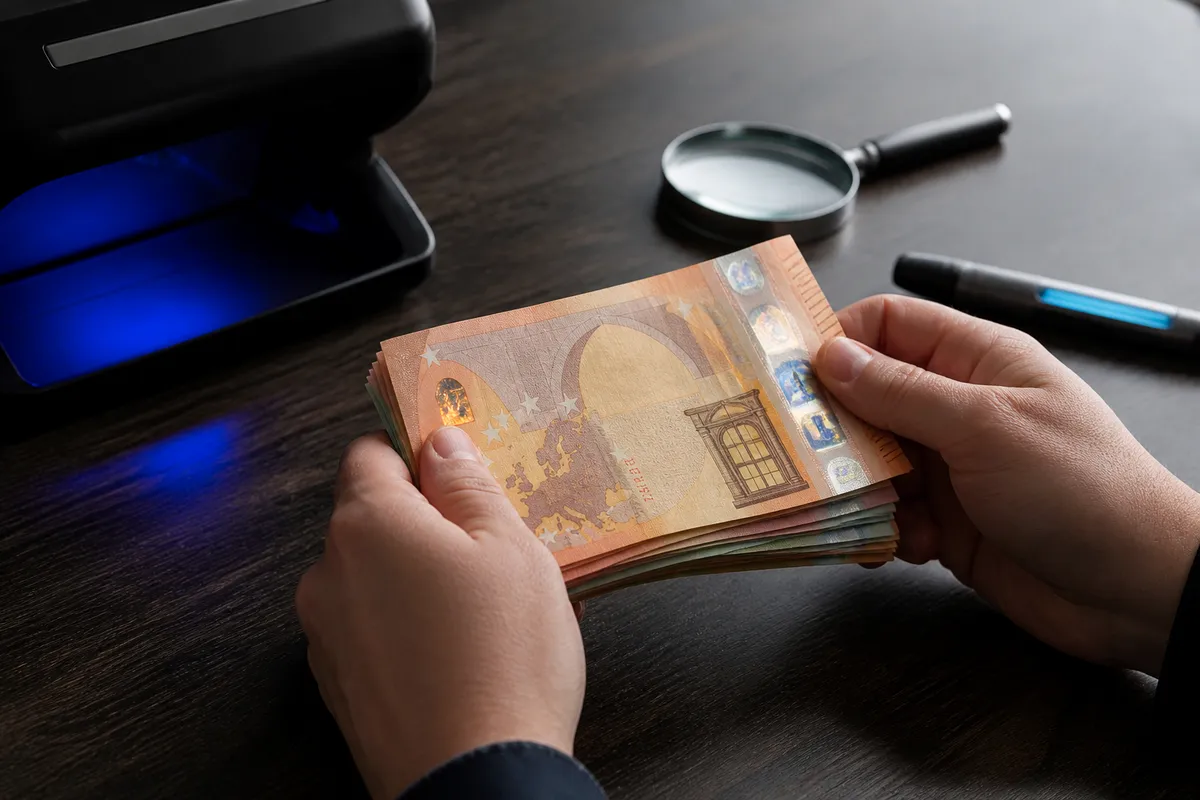
Implement counterfeit detection tools such as UV lights and magnifiers. UV lights help identify invisible security features present in genuine banknotes. Magnifiers can assist in checking for microprinting and other fine details that are difficult to replicate.
Train Employees
Training employees to recognize counterfeit currency is essential. They should learn to use the "feel, look, and tilt" method recommended by the European Central Bank for euro banknotes (6). This includes checking the texture, inspecting watermarks, and observing color-shifting ink. Regular training sessions can keep staff updated on the latest counterfeiting techniques and security features.
Verify Large Bills
Be especially cautious when accepting large bills. In 2023, €20 and €50 euro banknotes made up over 70% of counterfeit notes withdrawn from circulation (6). Businesses should establish a policy for verifying these denominations, using both technological tools and manual checks.
Rely on Security Features
Familiarize staff with the security features of the currency they commonly handle. For U.S. dollars, key features include the color-shifting ink, security threads, and watermarks (4) (5). For euros, features like the watermark and security thread are critical (6). Emphasizing these characteristics can help employees confidently identify genuine bills.
Implement a Reporting System
Create a clear procedure for reporting suspected counterfeit currency. If a counterfeit note is received, employees should record transaction details and notify local law enforcement immediately. Storing the suspect note separately without further handling is also crucial for maintaining evidence (9).
Stay Informed
Stay updated on the latest trends in counterfeiting. The U.S. Secret Service and local law enforcement agencies often provide resources and updates on counterfeiting activity. Regularly reviewing these materials can enhance a business’s defenses against counterfeit currency.
By utilizing these strategies, businesses can significantly reduce their risk of accepting counterfeit currency. Awareness and diligence play vital roles in maintaining financial integrity.
Common Mistakes and Misconceptions
Relying solely on counterfeit detection pens
Many businesses use detection pens as their only verification method. These pens can give false positives or negatives, especially on certain paper types (9). Always combine pen tests with checks for watermarks, security threads, and color-shifting ink.
Assuming only high denominations are counterfeited
Some focus verification efforts only on $100 or €100 bills. In reality, €20 and €50 notes made up over 75% of counterfeit euros in 2024 (7). Lower denominations are often targeted because they circulate more frequently.
Believing counterfeit money is always obvious
Modern counterfeits can closely mimic genuine bills, using high-quality printing and some security features. Genuine U.S. currency includes microprinting and embedded fibers that are difficult to replicate perfectly (4) (10). Always inspect bills carefully.
Thinking banks will replace counterfeit notes
Depositing a counterfeit bill results in confiscation and loss of value, with no compensation from banks (9). Once detected, the note is removed from circulation, and the depositor bears the loss.
Ignoring the legal risks of handling counterfeit cash
Some assume accidental possession carries no consequences. In the U.S., knowingly or unknowingly passing counterfeit money can lead to severe penalties, including up to 20 years in prison (2) (3). Always report suspected counterfeits to law enforcement immediately (9).
Careful verification and awareness of these pitfalls reduce the risk of financial and legal trouble.
Key Takeaways
Counterfeiting is a serious crime with penalties up to 20 years in prison in the U.S. and minimum 8 years in the EU (2) (3) (8)
€20 and €50 notes account for over 75% of counterfeit euros in circulation (6) (7)
Detection pens are unreliable; always check watermarks, security threads, and color-shifting ink (9) (4) (5)
Banks do not replace counterfeit bills—depositors lose the value (9)
Businesses should train staff, use detection tools, and report suspected counterfeits immediately (6) (9)
For a deeper understanding of how to identify fake bills, explore Fake US Dollars: How to Spot Them.
Good to know
What does 'counterfeit currency' mean?
Counterfeit currency is a medium not issued by a monetary authority but designed to imitate genuine currency’s appearance and physical features enough to deceive the public and function as real money (1). It is illegal to produce, possess, or pass such notes.
What is the most difficult currency to counterfeit?
U.S. currency is among the hardest to counterfeit due to advanced security features like 3-D Security Ribbons, color-shifting ink, watermarks, and microprinting (4) (10). Euro banknotes also include complex features, but €20 and €50 notes remain the most frequently counterfeited (7).
What happens if you take counterfeit money to a bank?
Banks confiscate counterfeit notes and do not compensate the depositor. If you knowingly deposit fake money, you may face legal consequences, as passing counterfeit currency is a federal crime in the U.S. (9).
I got a fake $100 bill what do I do
Store the suspect note separately, do not pass it to others, and immediately notify local police or the U.S. Secret Service. Surrender the bill to law enforcement for investigation (9).
Sources and further reading
- Measures of the People's Bank of China for the Administration of Currency Identification and Counterfeit Currency Seizure and Authentication
- U.S.C. Title 18 - CRIMES AND CRIMINAL PROCEDURE
- 18 USC 472: Uttering counterfeit obligations or securities
- Training Course - Security | U.S. Currency Education Program
- Know Your Money - U.S. Secret Service
- Number of counterfeit euro banknotes remains low in 2023
- Number of counterfeit euro banknotes continues to be low in 2024
- Directive - 2014/62 - EN - EUR-Lex
- The Fed - How do I determine if a banknote is genuine?
- Dollars in Detail: Your Guide to U.S. Currency