Counterfeit 1996 series 100 dollar bill
- First published:
- 13 min read
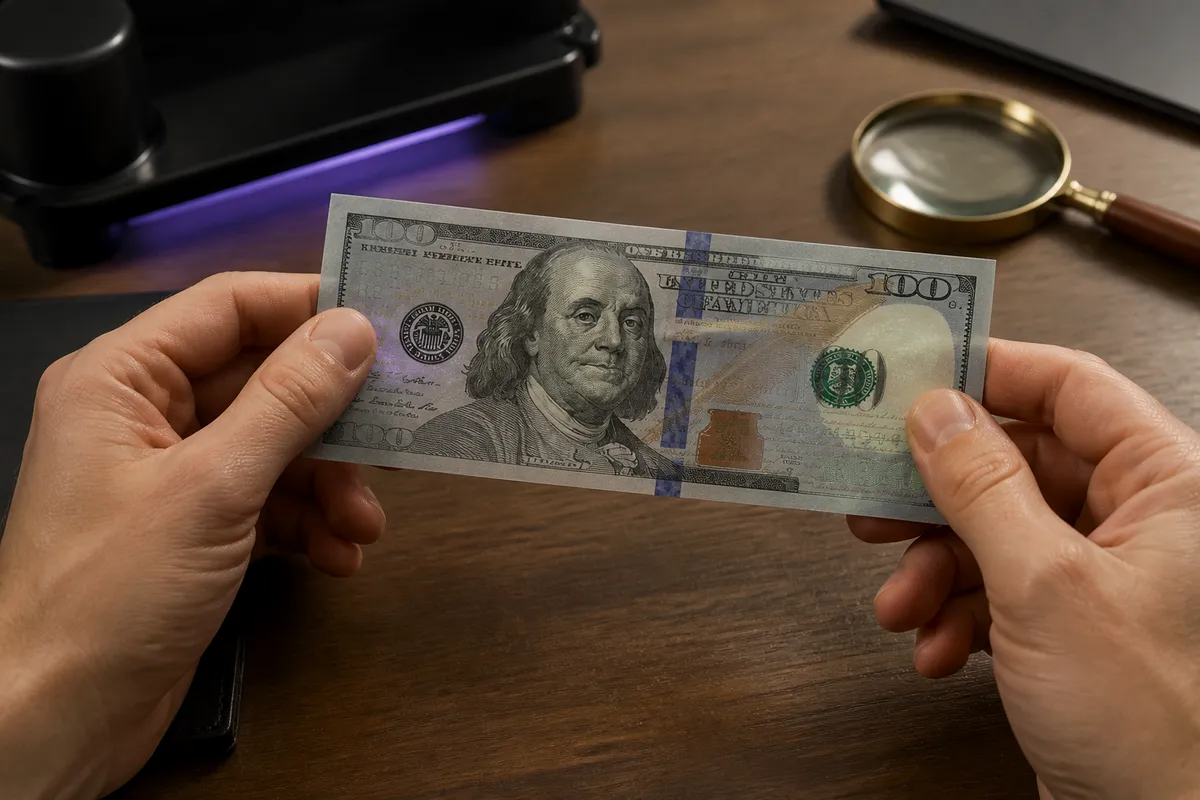
What Makes the 1996 Series $100 Bill Unique?
The 1996 series $100 bill marked the first significant redesign of U.S. currency in 66 years. This update aimed to enhance security and deter counterfeiting efforts, reflecting the increasing sophistication of counterfeiters (3). The redesign introduced several key features that set it apart from earlier versions.
One notable change is the incorporation of a security thread. This thread is embedded vertically to the left of Benjamin Franklin's portrait and features the text "USA 100." Under ultraviolet light, it glows pink, making it difficult for counterfeiters to replicate (1). Additionally, the bill includes a watermark of Franklin, which is visible when held up to the light. This watermark is located in the blank space to the right of the portrait (2).
Another significant feature is the use of color-shifting ink. The numeral "100" in the lower right corner changes from green to black when the bill is tilted, further complicating counterfeiting (2). The 1996 bill also includes microprinting, which consists of tiny text hidden within the design. This text requires magnification to read and serves as an additional security measure (1).
Comparing the 1996 series to pre-1996 bills highlights the advancements made. Earlier designs lacked a watermark, making them easier to counterfeit. The 1996 series introduced not only the security thread and watermark but also a unique 11-character serial number, which appears twice on the front. The first letter of this serial number corresponds to the series year, such as "A" for 1996 (4).
In summary, the 1996 series $100 bill is a significant advancement in currency design, featuring multiple counterfeit deterrents. These innovations enhance the bill's security and make it easier for the public to identify genuine notes.
Security Features of the 1996 Series $100 Bill
The 1996 series $100 bill incorporates several visible security features designed to prevent counterfeiting. Understanding these features can help the reader identify genuine bills.
Security Thread
A security thread is embedded vertically to the left of Benjamin Franklin's portrait. This thread reads "USA 100" and glows pink when exposed to ultraviolet light, making it difficult for counterfeiters to replicate accurately (1).
Watermark
The watermark of Benjamin Franklin is located in the blank space to the right of the portrait. When the bill is held up to the light, this watermark becomes visible, providing an additional layer of security (2).
Color-Shifting Ink
The numeral "100" in the lower right corner of the bill uses color-shifting ink. When tilted, this numeral changes from green to black. This feature is easily noticeable and serves as an effective counterfeit deterrent (2).
Microprinting
Microprinting appears in several areas of the bill, including the text "USA 100" within the numeral in the lower left corner and "THE UNITED STATES OF AMERICA" on Franklin's coat. This text is so small that it requires magnification to read, adding complexity for counterfeiters (1).
Raised Printing
Genuine 1996 series $100 bills feature raised printing. Running a finger along the surface will reveal a distinctive texture. This tactile feature is a reliable method for authentication (5).
Serial Numbers
Each 1996 series $100 bill has a unique 11-character serial number. This number appears twice on the front, with the first letter indicating the series year, such as "A" for 1996 (4).
Federal Reserve System Seal and Treasury Seal
The Federal Reserve System seal is located to the left of the portrait, while the Treasury seal is on the right. Both seals are essential elements for verifying authenticity (1).
Recognizing these security features can significantly reduce the risk of accepting counterfeit currency. Each feature offers a different method for verification, ensuring that genuine notes stand out.
How to Spot a Counterfeit 1996 Series $100 Bill
Identifying a counterfeit 1996 series $100 bill involves a systematic approach. Follow these steps to verify authenticity:
Check the Security Thread: Look for the embedded thread on the left side of Franklin's portrait. It should read "USA 100" and glow pink under UV light (1).
Examine the Watermark: Hold the bill up to the light to see the Franklin watermark in the blank space to the right of the portrait (2).
Test the Color-Shifting Ink: Tilt the bill to observe the numeral "100" in the lower right corner change from green to black (2).
Feel the Paper Texture: Genuine bills are printed on a special paper made of 25% linen and 75% cotton, giving it a distinct texture. Run your finger over the surface to detect raised printing (5) (1).
Inspect for Microprinting: Use a magnifying glass to check for the tiny text "USA 100" within the numeral in the lower left corner and "THE UNITED STATES OF AMERICA" on Franklin’s coat (1).
Verify Serial Numbers: Each bill has a unique 11-character serial number. The first letter corresponds to the series year, so look for "A" if it’s a 1996 bill (4).
Check the Seals: Ensure the Federal Reserve System seal on the left and the Treasury seal on the right are present and clear (1).
Common Red Flags in Counterfeit Bills
Be aware of these common signs that may indicate a counterfeit:
Blurry Printing: Genuine bills feature sharp, clear printing. Blurriness is a strong indicator of a fake.
Missing Security Features: If the security thread, watermark, or color-shifting ink are absent, it’s likely counterfeit.
Mismatched Serial Numbers: All serial numbers should be consistent. Any discrepancies or unusual formatting can be a warning sign.
Real vs. Fake Examples
A real 1996 series $100 bill will have a crisp feel, vibrant colors, and all the security features mentioned above. In contrast, a counterfeit might feel flimsy, have dull colors, or lack the specific security elements.
By following this checklist, the reader can confidently assess the authenticity of a 1996 series $100 bill.
Serial Numbers and Series Year: What to Look For
The serial numbers on the 1996 series $100 bill consist of 11 characters: two letters followed by nine digits. The first letter corresponds to the series year, with "A" indicating 1996. This unique format helps in identifying the authenticity of the bill (4).
To verify if the serial numbers match, check both the front and back of the bill. The serial number should appear twice on the front, and it must match the one printed on the back. Discrepancies can be a strong indicator of a counterfeit (4).
The series year, such as 1996 or 1999, signifies when the bill was printed. This aspect is crucial because the U.S. Treasury periodically updates the design and security features of currency. Knowing the series year helps in understanding which security features should be present. For example, the 1996 series $100 bill includes advanced features like a security thread and watermark, which are not found in older designs (3) (1).
In summary, familiarize yourself with the serial number format and series year. This knowledge aids in recognizing genuine bills and detecting potential counterfeits.
Common Counterfeit Mistakes in 1996 Series Bills
Counterfeiters often make noticeable mistakes when replicating the 1996 series $100 bill. Understanding these common errors can help the reader spot fakes more easily.
Frequent Errors in Fake Bills
Incorrect Color-Shifting Ink: The genuine bill features color-shifting ink on the numeral "100" that changes from green to black when tilted. Counterfeiters may use standard ink that does not shift colors or shifts poorly (2).
Missing Security Thread: The 1996 series includes a vertical security thread that reads "USA 100" and glows pink under UV light. Many counterfeit bills either lack this thread entirely or poorly replicate it (1).
Poorly Replicated Watermark: The Franklin watermark should be visible when held to the light. Counterfeiters might create a watermark that is either absent or not discernible (2).
Wrong Paper Texture: Genuine notes are made from a special blend of 25% linen and 75% cotton, giving them a unique texture. Counterfeit bills may feel too smooth or flimsy (1).
Inaccurate Microprinting: The 1996 series includes microprinting that is difficult to replicate. Counterfeiters often skip this feature or produce it poorly, making it unreadable (1).
Why These Mistakes Are Easy to Spot
Counterfeiters frequently overlook complex features that require precision to replicate. These include the color-shifting ink and microprinting, which are not only hard to reproduce but also essential for authenticity. As a result, these errors become glaringly obvious during inspection.
Real-Life Examples of Counterfeit Bills
Many counterfeit bills have surfaced with distinct flaws. For instance, some may feature blurry printing that lacks the crispness of genuine notes. Others might have mismatched serial numbers or missing security features. These discrepancies are common indicators of counterfeits.
By familiarizing oneself with these frequent errors, the reader can better protect themselves from accepting counterfeit 1996 series $100 bills.
Is a 1996 Series $100 Bill Still Valid or Valuable?
The 1996 series $100 bill remains valid and is widely accepted as legal tender. Older-design Federal Reserve notes do not require replacement and continue to circulate alongside newer bills (5).
Factors Affecting Collectible Value
While the 1996 series $100 bill is still usable, its collectible value can vary significantly. Several factors influence this value:
Condition: Bills in uncirculated condition command higher prices. Creases, folds, or wear can diminish value.
Rarity: Certain 1996 bills are rarer than others. For example, star notes—bills that replace misprinted notes—are often more sought after.
Serial Number Patterns: Low serial numbers or unique patterns can increase a bill's desirability. Collectors often seek specific sequences, such as all zeros or repeating numbers.
Current Market Value
Current market values for 1996 series $100 bills fluctuate based on condition and rarity. Circulated bills typically sell for close to face value, around $100, while uncirculated notes can fetch prices between $150 to $300 or more, depending on their condition and rarity. Star notes or bills with unique serial numbers can exceed this range, sometimes reaching $500 or higher in collector markets.
Understanding these aspects can help the reader appreciate the value of 1996 series $100 bills, whether for spending or collecting.
Tools and Resources for Verifying Authenticity
Verifying the authenticity of a 1996 series $100 bill involves using specific tools and resources. Here’s a list of free tools and how to use them effectively.
UV Light
A UV light is crucial for detecting the security thread. This thread, embedded vertically to the left of Benjamin Franklin's portrait, glows pink under ultraviolet light. To use it, simply shine the UV light on the bill. If the thread is visible and glows as expected, the bill is likely genuine (1).
Magnifying Glass
A magnifying glass helps inspect microprinting, which is a security feature on the bill. Look for the text "USA 100" within the numeral in the lower left corner and "THE UNITED STATES OF AMERICA" on Franklin’s coat. These details require magnification to view clearly (1). Hold the glass close to the bill while focusing on these areas.
Official US Treasury Guides
The U.S. Bureau of Engraving and Printing provides official guides detailing the security features of U.S. currency. These guides can be found on their website and offer comprehensive information about verifying authenticity. They include images and descriptions of features like the watermark and color-shifting ink, which are essential for identification (6).
Raised Printing Test
Running your finger along the surface of the bill can reveal raised printing, a tactile feature of genuine notes. Genuine 1996 series $100 bills have a distinct texture, while counterfeit bills often feel smooth (5). This simple test can be done anywhere and is a reliable method for authentication.
Serial Number Check
Each 1996 series $100 bill has a unique 11-character serial number. Check that the serial number appears twice on the front and matches between the front and back of the bill. The first letter should correspond to the series year, with "A" indicating 1996 (4). Discrepancies in the serial number can indicate a counterfeit.
Utilizing these tools effectively can help the reader confidently verify the authenticity of a 1996 series $100 bill. Make sure to familiarize yourself with these features for a more accurate assessment.
Common Misconceptions and Mistakes
Ignoring the Security Thread Under UV Light
Many assume the security thread is just a visual feature. In reality, it must glow pink under UV light and read “USA 100” when held up (1). Fakes often have a plain thread or none at all.
A cheap UV light reveals this instantly.
Overlooking the Watermark
Some think the blank space next to Franklin is just empty. The genuine bill shows his watermark when held to the light (2). Counterfeits either skip it or print a blurry image that doesn’t align.
Always check this in natural or bright light.
Assuming All Ink Shifts Color
The color-shifting ink only applies to the numeral “100” in the lower right corner. It changes from green to black when tilted (2). Fakes may use flat ink or a poor imitation that doesn’t shift smoothly.
Tilt the bill slowly to confirm the effect.
Trusting Smooth or Glossy Paper
Genuine 1996 bills use a cotton-linen blend with a distinct texture and embedded fibers (1). Counterfeits often use standard paper that feels too smooth or shiny.
Run your fingernail over the surface to feel the difference.
Skipping the Magnifying Glass for Microprinting
Microprinting is easy to miss without magnification. Look for “USA 100” in the lower left numeral and “THE UNITED STATES OF AMERICA” on Franklin’s coat lapel (1). Fakes either omit it or print gibberish.
A 10x magnifying glass is enough to spot the details.
Focusing on these details separates real bills from convincing fakes.
Key Takeaways
Security features are non-negotiable: missing color-shifting ink, watermark, or UV thread means the bill is fake.
Serial numbers must match front and back, with the first letter corresponding to the series year.
Texture and paper quality differ from standard paper—genuine bills use a cotton-linen blend with raised printing.
Common counterfeit errors include blurry microprinting, incorrect ink, or a missing security thread.
For a deeper dive into spotting counterfeit currency, explore Fake US Dollars: How to Spot Them.
Good to know
How to tell if a $100 bill from 1996 is real?
Check the color-shifting ink on the numeral '100' in the lower right corner—it should change from green to black when tilted (2). Hold the bill to the light to see the Franklin watermark and embedded security thread reading 'USA 100' (1) (2). Genuine bills also have raised printing and a cotton-linen texture (1) (5).
How to tell if old $100 bills are fake?
Look for missing or poorly replicated security features: the vertical security thread glowing pink under UV light, the Franklin watermark, and color-shifting ink (1) (2). Counterfeits often lack microprinting or use smooth paper instead of the cotton-linen blend (1).
Is a $100 bill from 1996 worth anything?
The 1996 series $100 bill remains legal tender and is still valid for use (5). Collectible value depends on condition, rarity, or unique serial numbers—uncirculated bills can fetch $150–$300, while star notes or rare patterns may exceed $500.
How can I tell if a $100 dollar note is real or fake?
Verify the security thread (glows pink under UV light), watermark (Franklin’s image), and color-shifting ink on the '100' numeral (1) (2). Use a magnifying glass to check microprinting and feel for raised printing and cotton-linen texture (1) (5).
Counterfeit 1996 series 100 dollar bill real or fake
A genuine 1996 series $100 bill has a security thread, watermark, color-shifting ink, and microprinting (1) (2) (1). If any of these features are missing, blurred, or incorrect, the bill is likely counterfeit.
1996 Series 100 dollar bill serial number
The 11-character serial number appears twice on the front, with the first letter indicating the series year (e.g., 'A' for 1996) (4). The number must match on both sides of the bill—discrepancies suggest a counterfeit.
Sources and further reading
- $100 Note Features (1996–2013) | U.S. Currency Education Program
- $100 Note | U.S. Currency Education Program
- The Issuance of Series-1996 $100 Federal Reserve Notes | Federal Reserve Bulletin
- Serial Numbers | Bureau of Engraving and Printing
- Use of Older-Design Notes | U.S. Currency Education Program
- Treasury and Federal Reserve Announce New Currency Design | U.S. Department of the Treasury